Certified English to Southern IsiNdebele Translation Services
As South Africa's 11th most-spoken language, isiNdebele is spoken by over 1.1 million people concentrated in Mpumalanga, Gauteng and Limpopo. Our English to isiNdebele translators deliver accurate, culturally authentic translations that meet rigorous quality standards for legal and educational sectors.
We specialise in serving Ndebele-speaking communities across key regions with:
- Legal documents: Certified translations for court filings, contracts and official government documents
- Educational materials: CAPS-aligned textbooks and curriculum resources for schools
- Regional expertise: Deep understanding of Mpumalanga and Gauteng Ndebele dialects
Every translation is handled by first-language isiNdebele linguists who ensure your documents maintain both technical accuracy and cultural relevance for Ndebele-speaking audiences.
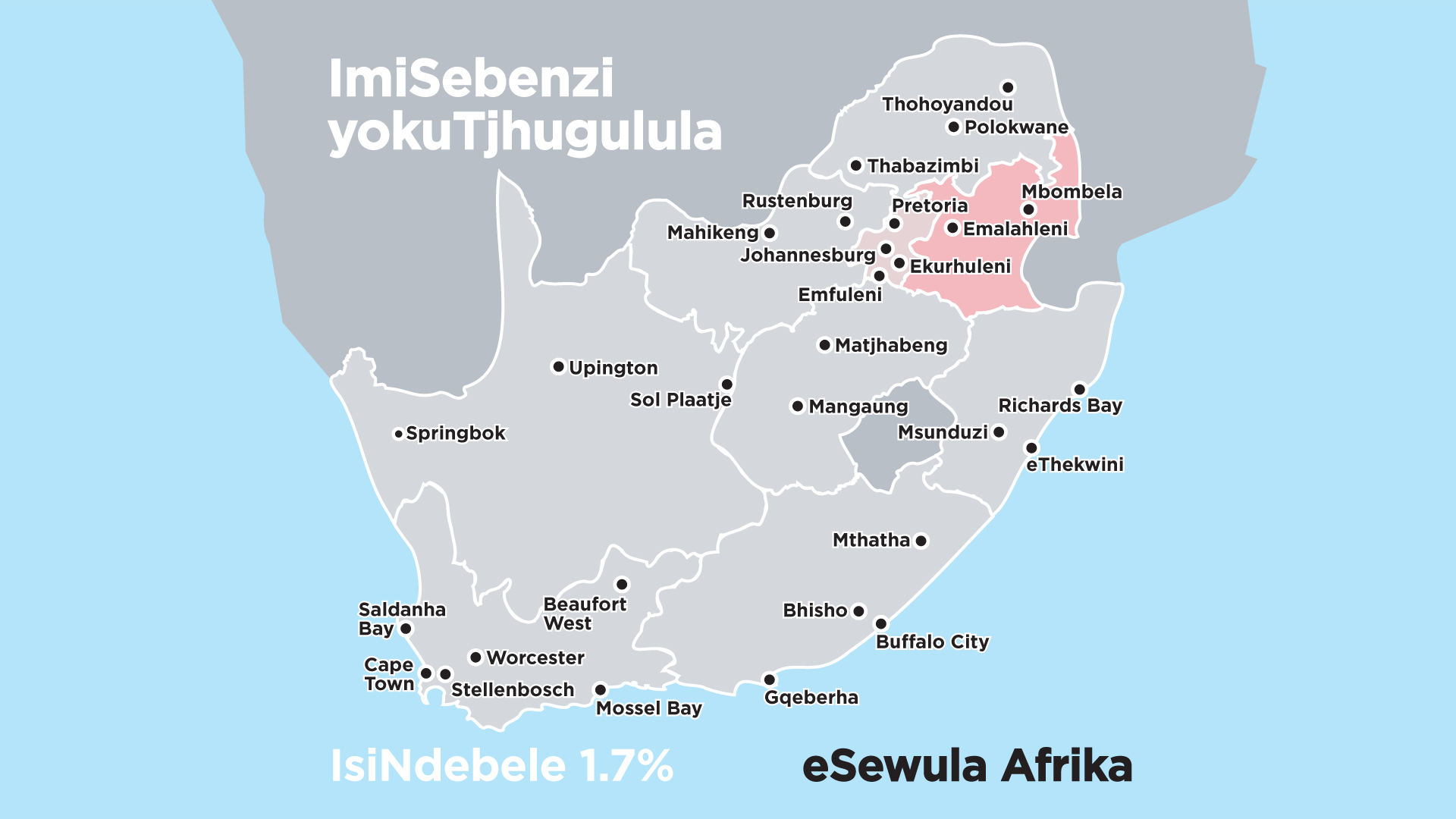
IsiNdebele translation services cover Ndebele communities across Mpumalanga, Gauteng and Limpopo provinces, serving over 1.1 million speakers.
IsiNdebele Translation Services for Pretoria, Johannesburg & KwaMhlanga
According to the 2022 South African Census, isiNdebele is South Africa's eleventh largest home language, spoken by 1.7% of South Africans, an estimated 1,053,711 people. English is spoken by 8.7% of South Africans (5,388,221 people). In the Nkangala District of Mpumalanga where isiNdebele is most concentrated, English is not a competing language but a negligible one.
IsiNdebele Translation Services in Pretoria
Tshwane has the largest urban concentration of isiNdebele speakers of any city in South Africa, with 163,603 home speakers (5.6%). National departments and public entities headquartered in Pretoria with responsibilities across Mpumalanga face a consistent requirement for certified isiNdebele translation in public communications, regulatory notices and community-facing compliance materials. Our translation services in Pretoria support public sector clients, law firms and consultancies managing national communications that must reach the Nkangala District.
IsiNdebele Translation Services in Johannesburg
Our translation services in Johannesburg reach 128,610 isiNdebele home speakers in the City of Johannesburg. Combined with Pretoria's 163,603, the two Gauteng metros together account for nearly 300,000 isiNdebele home speakers, a substantial urban workforce audience for organisations whose isiNdebele translation requirements arise from Mpumalanga operations but extend into Gauteng employment contracts and compliance documentation.
IsiNdebele Translation Services in KwaMhlanga
KwaMhlanga is the administrative centre of the Nkangala District and the heartland of isiNdebele-speaking South Africa. Thembisile municipality, which includes KwaMhlanga, records 181,307 isiNdebele home speakers (58.4%) against just 3,725 English speakers (1.2%), a ratio of 49 to one. Dr JS Moroka (Siyabuswa) adds a further 90,144 speakers (36.1%) against 2,996 English (1.2%), and Elias Motsoaledi (Groblersdal) 37,155 (14.9%) against 3,242 English (1.3%). Emalahleni (Witbank) adds a further 35,196 isiNdebele speakers (8.9%). For organisations producing compliance documents, community communications or consultation materials for Nkangala District audiences, certified isiNdebele translation reaches a community that English-only content does not address.
IsiNdebele Translation Services in Cape Town
Mpumalanga's Nkangala District sits at the centre of South Africa's coal belt, and several of the energy companies, mining groups and infrastructure developers with operations around Emalahleni (Witbank) and the surrounding coalfields maintain head offices or legal counsel in Cape Town. Social Labour Plans, community engagement documents and employment contracts produced at head office level for these operations regularly require certified isiNdebele translation. Our translation services in Cape Town support these clients alongside Western Cape-based educational publishers and NGOs producing materials for Mpumalanga schools and community programmes.
| Municipality (City) | Population | IsiNdebele Speakers | % IsiNdebele | English Speakers | % English |
|---|---|---|---|---|---|
| City of Tshwane (Pretoria) | 2,921,488 | 163,603 | 5.6% | 245,405 | 8.4% |
| Thembisile (KwaMhlanga) | 310,458 | 181,307 | 58.4% | 3,725 | 1.2% |
| City of Johannesburg | 4,434,827 | 128,610 | 2.9% | 878,096 | 19.8% |
| Dr JS Moroka (Siyabuswa) | 249,705 | 90,144 | 36.1% | 2,996 | 1.2% |
| Elias Motsoaledi (Groblersdal) | 249,363 | 37,155 | 14.9% | 3,242 | 1.3% |
| Emalahleni (Witbank) | 395,466 | 35,196 | 8.9% | 22,146 | 5.6% |
Southern isiNdebele Digital and Localisation Services
From Mpumalanga government communications and municipal notices to educational platforms serving isiNdebele-speaking schools, digital content in isiNdebele reaches communities across Mpumalanga, Gauteng and Limpopo.
To see our full capabilities, our website localisation services translate your content for isiNdebele audiences. You can also view our localised homepage ImiSebenzi yokuTjhugulula yamaLimi weSewula Afrika to see an example of our formal and technical translation capabilities.
IsiNdebele Translation Quality and Certification
- First-language specialists: Certified isiNdebele translators with decade-plus experience in legal and educational sectors.
- Technical precision: Advanced verification tools ensuring spelling and terminology accuracy.
- Official certification: Legally recognised certificates for court and government documents.
- Educational alignment: Curriculum-specific translations meeting CAPS requirements.
- Authentic approach: Exclusively human translation preserving linguistic integrity.
Get Your Certified IsiNdebele Translation Quote
Our certified translators deliver culturally precise isiNdebele translations for legal, educational and community documents across Mpumalanga and Gauteng. Email info@iitranslation.com and attach your documents for a personalised quote within 5 minutes (7:30am - 5pm SAST).
Frequently Asked Questions: IsiNdebele Translation Services
How are the costs for an isiNdebele translation project determined?
As a specialist isiNdebele translation agency, we use a transparent per-word rate for all assignments. This provides our clients with total cost certainty: the quote you approve is the final price you pay, with no hidden administration fees or surcharges. Our rates for English to isiNdebele and isiNdebele to English are based on the technicality and total volume of the text, including legal contracts, educational curriculum materials and community health notices. Our minimum project cost is R500 + VAT. We maintain a flat-rate policy and never charge premium rush fees for high-priority projects. Most corporate and government departments should receive a formal quotation within 5 minutes during normal business hours.
What is the typical timeframe for isiNdebele translation delivery?
The delivery schedule is based on the word count and also influenced by the complexity of the subject matter. We commit to a firm delivery date only after a qualified native speaker has reviewed your files. For time-critical projects, urgent isiNdebele translation with a 24-hour turnaround can be pre-arranged, such as urgent community notices or legal updates. If you are working toward a non-negotiable deadline, please highlight this in your inquiry for immediate confirmation of our capacity.
How do you distinguish South African Southern isiNdebele from the Ndebele spoken in Zimbabwe?
This is a vital distinction for professional compliance. South African isiNdebele (Southern Ndebele) is a distinct official language with its own unique orthography and grammatical structure, separate from the Northern Ndebele spoken in Zimbabwe. In the South African business and legal context, isiNdebele refers exclusively to the local variety. We only work with the South African variety, adhering to the standards required for Mpumalanga schools and Gauteng government departments. This ensures your content is linguistically accurate and legally compliant within the borders of South Africa.
Do you provide certified or sworn isiNdebele translation for official use?
Yes. We offer certified isiNdebele translation for legal contracts, court submissions, PAIA manuals and official tenders, produced by university-qualified isiNdebele linguists and passed through our ISO 17100:2015-compliant editorial process. Note that because the South African government does not issue personal records (such as birth or marriage certificates) in isiNdebele, the demand for sworn translations for personal use is virtually non-existent. Our focus remains on high-level institutional communication and technical paperwork where legal compliance and linguistic precision are both required. Explore our legal translation expertise.
Does South Africa have official requirements for isiNdebele translations of government documents?
Yes. For institutional and official use, including Mpumalanga provincial government documents, Thembisile Hani and Dr JS Moroka municipal communications, PAIA manuals and Social and Labour Plans, a compliant isiNdebele translation must meet four core requirements. First, the translator must be a first-language South African isiNdebele speaker. This matters particularly for isiNdebele, where the South African and Zimbabwean variants are distinct languages with different orthographies. A linguist trained in Northern Ndebele is not equipped for South African institutional documentation. Second, the linguist must hold an academic qualification in their home language, typically a university degree in isiNdebele linguistics or applied language studies. Third, the translator must have demonstrated subject-matter experience in the relevant field: a linguist qualified in general translation is not the right choice for a Social and Labour Plan or a community health protocol. Fourth, the translation must pass a quality control process that leaves the document in a print-ready state, meaning it has been run through an editing phase where it is proofread for readability and checked for consistency and any spelling or grammar errors that were missed in the primary translation. All four conditions are applied as standard on every project we accept.
Are your isiNdebele translations performed by native speakers and can AI accurately translate isiNdebele?
Every project is handled exclusively by native South African isiNdebele speakers with university degrees in linguistics and a minimum of 10 years of subject-matter experience. Our quality assurance process combines a primary translation phase by a subject-matter specialist with independent proofreading and our proprietary localised terminology checks. This human-only workflow ensures that our output is print-ready and orthographically consistent with the South African standard, which is essential given the orthographic differences between Southern and Northern Ndebele.
AI cannot meet this standard for isiNdebele. With approximately 180 Wikipedia articles, South African isiNdebele has the smallest digital footprint of all 11 official South African languages and is the most data-scarce of any language we work with. AI models have almost no usable training material for the language and the consequences are severe and consistent: hallucinated vocabulary, heavy borrowing from related Nguni languages like isiZulu and isiXhosa, and systematic failures on grammar. The cross-border variant problem compounds this further: what little isiNdebele training data exists is contaminated with Northern Ndebele material from Zimbabwe, producing output that blends two incompatible orthographic systems. Using AI output as a draft is not a cost-saving measure. It is a reconstruction job that takes longer and costs more than translating from the source.
To see the scale of the digital gap for isiNdebele in context, view the data comparing South African language availability for AI training on our dedicated FAQ page.
Is your isiNdebele translation standardised for schools and government use?
Yes. We provide a formal, broadcast-quality register that is standardised for educational materials and government communications. Our linguists are first-language speakers who understand the nuances required for the Mpumalanga highveld and urban Gauteng. By adhering to the standardised South African isiNdebele dialect, we ensure your message is universally understood in Siyabuswa, KwaMhlanga and Bronkhorstspruit, avoiding localised street slang while maintaining professional authority.
Which geographic regions do your isiNdebele services cover?
Our isiNdebele translation services primarily serve the cultural heartlands of Mpumalanga and the major economic hubs of Gauteng. This includes dedicated support for organisations operating in Thembisile Hani and Dr JS Moroka municipalities, as well as corporate offices in Pretoria and Johannesburg. We provide the linguistic bridge necessary for effective Social and Labour Plan (SLP) communication and community engagement within these specific regions.
How do you handle the technical layout of isiNdebele documents?
We work directly with design teams across formats including Adobe InDesign, well-structured PDFs, HTML, XML and CSV. This allows us to deliver educational brochures and technical manuals that are ready for immediate print or digital deployment without losing formatting integrity. Software is only a support tool; our human-only quality assurance cycle ensures 100% linguistic accuracy and orthographic precision for the South African market.
How is the confidentiality of my sensitive isiNdebele files maintained?
We operate under a strict zero-sharing policy: your files are never processed by external AI platforms or stored in third-party translation memories. Your data remains entirely within our secure infrastructure, accessed only by the specific native linguist assigned to your project. Every member of our team is bound by a formal non-disclosure agreement. This level of security is fundamental for confidential HR records, legal documentation and commercially sensitive community reports. Full details of our security protocols are available in our Privacy Policy. We are always happy to sign NDAs if your organisation requires further assurance.
What is the difference between isiNdebele translation, interpreting and transcription?
For organisations new to commissioning isiNdebele language work, the distinction between these three services is worth establishing clearly. Translation is the written conversion of a document from one language to another, a deliberate quality-controlled process producing text fit for official submission, community distribution or publication. This is the only service we provide. Interpreting is the live oral facilitation of spoken communication, at a Thembisile Hani community engagement session, a Mpumalanga SLP public participation meeting or a disciplinary hearing in KwaMhlanga, for example. Transcription is the conversion of recorded audio or video into accurate written isiNdebele text, commonly required for stakeholder engagement recordings, focus groups or interviews that need to be archived or submitted in written form. Each is a distinct professional discipline. iiTranslation focuses entirely on professional written translation.
Clients