Certified English to Sepedi Translation Services
From universities in Pretoria, where a fifth of the city speaks Sepedi as their first language, to schools in Polokwane needing textbook translations, iiTranslation delivers culturally adapted Sepedi (Sesotho sa Leboa) solutions across Gauteng and Limpopo. Our certified English to Sepedi translators specialise in sector-specific terminology, ensuring educational materials, government communications and mining documents maintain technical accuracy while resonating authentically with local communities.
We translate textbooks, curriculum documents and public service announcements with meticulous attention to regional dialects and cultural context. For Pretoria's public sector and Limpopo's extensive mining operations, we transform complex technical jargon into clear, accessible Sepedi, ensuring regulatory compliance, workplace safety and meaningful community engagement with the language's 6.2 million speakers nationwide.
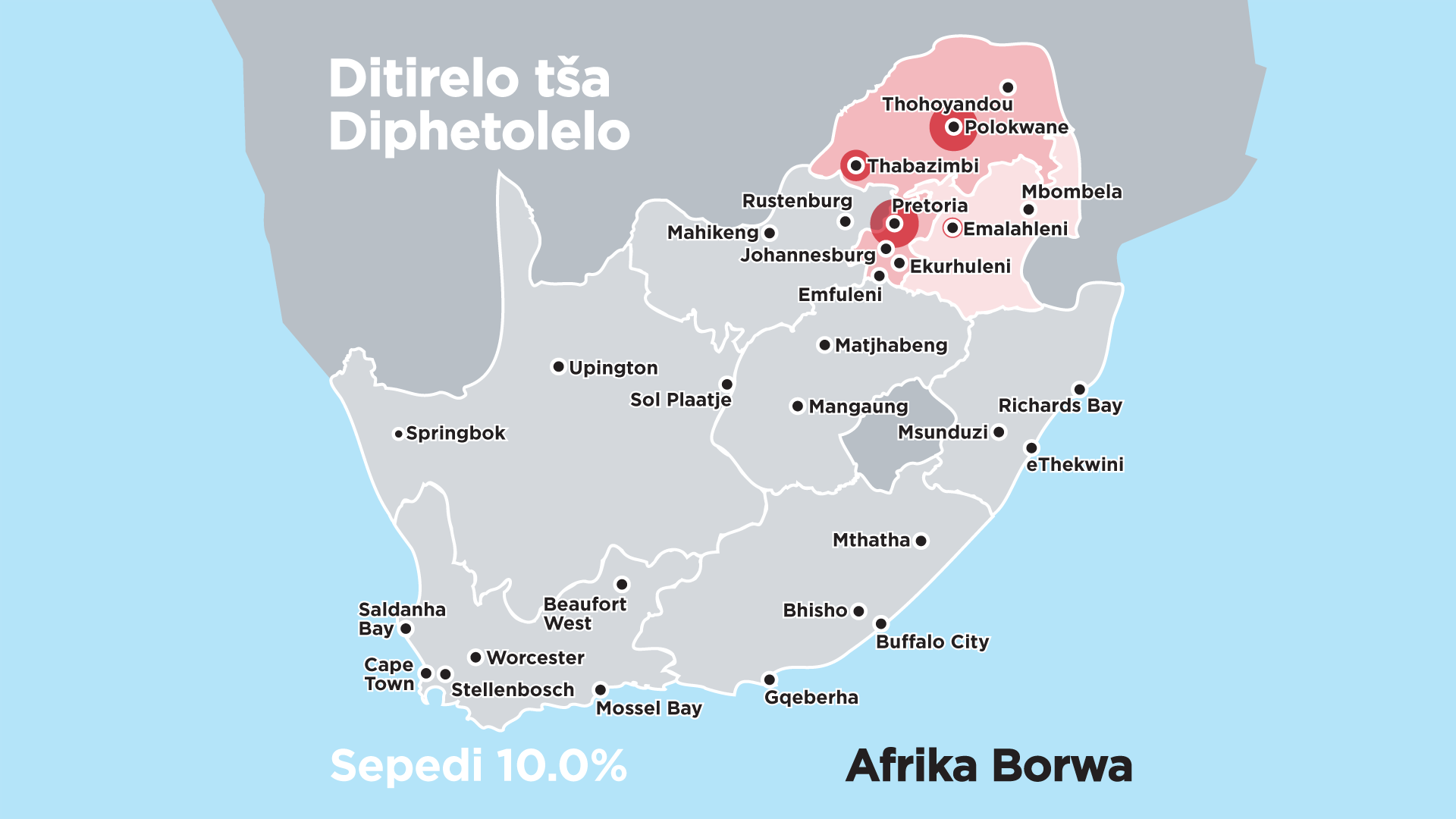
Sepedi is spoken by 55.5% of Limpopo residents (the province's dominant language), half of Polokwane's population and a fifth of Pretoria's residents (its most common language).
Sepedi Translation Services for Pretoria, Polokwane & Johannesburg
There is a strong incentive for organisations operating in the north of the country to translate their English materials into Sepedi. According to the 2022 South African Census, Sepedi (Sesotho sa Leboa) is South Africa's fourth largest home language, spoken by 10% of South Africans, an estimated 6,198,831 people. English is spoken by 8.7% of South Africans (5,388,221 people).
Sepedi Translation Services in Polokwane
The contrast between Sepedi and English speakers is most striking in Limpopo, where English is effectively a minority language. In Polokwane, 495,022 people speak Sepedi at home (78.7%) against just 19,499 English speakers (3.1%), a ratio of more than 25 to one. Greater Tubatse (Burgersfort) returns 87.5% Sepedi against 1.1% English, and Mogalakwena (Mokopane) 73.1% against 1.4%. In Greater Tzaneen and Bushbuckridge, Sepedi outnumbers English by 29 to one and 35 to one respectively. For organisations producing compliance documents or community communications for Limpopo audiences, certified Sepedi translation is not optional.
Sepedi Translation Services in Pretoria
Sepedi is Tshwane's most numerically significant non-English language. Our translation services in Pretoria reach 566,769 Sepedi home speakers, more than double the English-speaking population of 245,405 (8.4%). For government departments and compliance-driven organisations headquartered in the administrative capital, Sepedi translation is a practical necessity for any communication directed at Limpopo communities or Gauteng's large Northern Sotho-speaking workforce.
Sepedi Translation Services in Johannesburg
Our translation services in Johannesburg serve 678,000 Sepedi speakers across the City of Johannesburg and Ekurhuleni. For any organisation with a Gauteng customer base, workforce or supply chain, English-only content reaches a fraction of the intended audience wherever communications need to reach the city's large Northern Sotho-speaking population.
Sepedi Translation Services in Cape Town
Cape Town hosts a significant number of organisations that communicate nationally rather than regionally, including NGOs, universities, publishers and multinationals with Western Cape head offices. For these clients, Sepedi translation is not driven by local speaker numbers but by the need to reach Limpopo communities and Gauteng's large Northern Sotho-speaking workforce through a single national document or campaign. Our translation services in Cape Town regularly include Sepedi among the languages requested by Western Cape clients producing compliance materials, educational content or public-facing communications at national scale.
| Municipality (City) | Population | Sepedi Speakers | % Sepedi | English Speakers | % English |
|---|---|---|---|---|---|
| City of Tshwane (Pretoria) | 2,921,488 | 566,769 | 19.4% | 245,405 | 8.4% |
| Polokwane | 628,999 | 495,022 | 78.7% | 19,499 | 3.1% |
| Ekurhuleni (East Rand) | 3,178,470 | 359,167 | 11.3% | 378,238 | 11.9% |
| City of Johannesburg | 4,434,827 | 319,308 | 7.2% | 878,096 | 19.8% |
| Greater Tubatse (Burgersfort) | 335,676 | 293,716 | 87.5% | 3,692 | 1.1% |
| Mogalakwena (Mokopane) | 307,682 | 224,916 | 73.1% | 4,308 | 1.4% |
| Greater Tzaneen | 390,095 | 179,444 | 46.0% | 6,242 | 1.6% |
| Bushbuckridge | 541,248 | 132,606 | 24.5% | 3,789 | 0.7% |
| Emalahleni (Witbank) | 395,466 | 44,688 | 11.3% | 22,146 | 5.6% |
| Thembisile (KwaMhlanga) | 310,458 | 39,118 | 12.6% | 3,725 | 1.2% |
Precise Sepedi Textbook Translations for Limpopo's Schools
In Limpopo, where 55.5% of residents speak Sepedi as their first language, accurate textbook translations are essential for student success. We provide specialist educational translation for curriculum materials including mathematics, science and history, ensuring terminology aligns with CAPS standards while respecting regional dialects spoken in Polokwane.
Our university-qualified translators adapt complex pedagogical concepts into clear, written Sepedi for primary and secondary schools. Whether translating exam papers, teacher guides and digital learning tools, we prioritise linguistic accuracy to support student comprehension.
Sepedi Mining and Environmental Translation Services
Specialising in Limpopo's mining sector, we connect regulatory requirements with clear community communication. By simplifying technical jargon in safety manuals and ensuring Social and Labour Plans (SLPs) meet both DMR standards and local readability, we deliver professional mining translation services that empower informed decision-making.
From environmental impact assessments to safety protocols, we transform complex technical terminology into clear, written Sepedi. Our process ensures compliance documents and community reports are easily understood by workers, regulators and stakeholders.
Specialist Legal and Government Sepedi Translation Services
Accuracy is paramount in high-stakes legal documentation. Our Sepedi translators possess extensive parliamentary and legal experience, delivering professional legal translation services for contracts, affidavits and government publications.
Our meticulous quality control eliminates ambiguity in legal texts. We ensure every document maintains the formal register and authority of the original while remaining fully compliant with South African regulatory standards and the requirements of organs of state.
Sepedi Digital Translation and Localisation Services
With 6.2 million Sepedi speakers nationwide, approximately 10% of South Africans, digital content in this language reaches a substantial online audience across Limpopo, Gauteng and Mpumalanga. Our certified Sepedi translators help you engage this market through authentic localisation of websites, mobile apps and social campaigns.
To see our full capabilities, explore our website localisation services or view Ditirelo tša go Fetolela Maleme a Afrika Borwa, our Sepedi-translated homepage showcasing technical and formal language proficiency.
Get Your Certified Sepedi Translation Quote
With over a million words translated for 115+ institutional and corporate clients, we are South Africa's trusted partner for certified Sepedi communication. Our certified translators ensure your content resonates with cultural accuracy across Limpopo, Gauteng and Mpumalanga. Email us at info@iitranslation.com and attach your documents for a personalised quote within 5 minutes during business hours (7:30am - 5pm SAST).
Frequently Asked Questions: Sepedi Translation Services
How do you calculate Sepedi translation rates and project costs?
As a specialist Sepedi translation agency, we prioritise transparent project costings. We use a per-word pricing model with no hidden surcharges. The total provided in our quote is the final amount you will pay. Rates for English to Sepedi and Sepedi to English vary depending on the total volume and the technicality of the subject matter (particularly for legal, medical or mining documentation). Our minimum project cost is R500 + VAT. We maintain a flat rate for urgent requests and do not charge premium fees for faster turnarounds. Most government departments and corporate firms receive a firm quote within 5 minutes during business hours.
What is the typical turnaround for professional Sepedi translation?
The timeline for delivery is based on document length and the availability of a linguist specialising in your specific field. We only provide a guaranteed delivery time once the assigned translator has confirmed the deadline. For high-priority projects, urgent Sepedi translation with a 24-hour turnaround is available by prior arrangement, covering everything from Social and Labour Plan (SLP) updates to community notices. If you have a critical deadline, please mention it in your inquiry for immediate confirmation of availability.
Do you offer certified Sepedi translation for legal or official use?
Yes. We provide certified Sepedi translation for legal contracts, court submissions, PAIA manuals and government tenders. It is worth noting that because personal certificates such as marriage and birth records are not issued in Sepedi by government offices, there is effectively no demand for sworn translations in Northern Sotho. Our focus is on institutional communication and technical documentation, the content that actually matters for Limpopo and Gauteng organisations operating in Sepedi-speaking communities. Every document is produced by a university-qualified Sepedi linguist and passed through our ISO 17100:2015-compliant editorial process to ensure the final text is both legally compliant and linguistically precise. View our legal translation services.
Does South Africa have official requirements for Sepedi translations of government documents?
Yes. For institutional and official use, including Limpopo provincial government documents, mining sector compliance materials, PAIA manuals and Social and Labour Plans, a compliant Sepedi translation must satisfy four core requirements. First, the translator must be a first-language Sepedi speaker. Working knowledge of the language does not equip a linguist for the formal register that regulatory and legal documents demand. Second, the linguist must hold an academic qualification in their home language, typically a university degree in Sepedi or Northern Sotho linguistics. Third, the translator must have demonstrated subject-matter experience in the relevant field: a general linguist is not the right person for a mining safety procedure or a clinical research document. Fourth, the translation must pass a quality control process that leaves the document in a print-ready state, meaning it has been run through an editing phase where it is proofread for readability and, vitally, checked for consistency and any spelling or grammar errors that were missed in the primary translation. All four conditions are applied as standard on every project we accept.
Are your Sepedi translations performed by native speakers — and can AI handle Sepedi accurately?
Every assignment is handled exclusively by native Sepedi speakers with university degrees in linguistics and a minimum of 10 years of subject-matter experience. This human-only approach, which includes independent proofreading and our proprietary localised terminology checks, ensures that our output is print-ready. It is particularly vital for mining safety documentation, where Sepedi is our most frequently requested language for workforce safety communication and where a translation error carries direct consequences for workers on site.
AI cannot meet this standard for Sepedi. The idea of using AI output as a draft for a human to edit is a false economy. A qualified Sepedi linguist reviewing AI output will find errors at every level: individual word choices, sentence structure, terminology consistency and overall register. They are not editing a draft. They are rewriting it while cross-referencing a flawed source, which is a slower and more cognitively demanding process than translating the original document directly.
The root cause is data scarcity. There is not enough high-quality Sepedi text in existence for AI models to have learned the language accurately. The consequences are consistent and predictable: AI hallucinates, producing grammatically plausible-looking sentences that are factually or linguistically wrong. It borrows vocabulary from related languages such as Setswana and Sesotho, generating hybrid output that no native speaker would write. And it gets grammar wrong at a structural level, the noun-class system, concord rules and verb morphology that Sepedi requires are precisely the features that data-starved models handle worst. This is not a solvable problem with better prompting. It is a data scarcity problem that affects Sepedi, Sesotho, Setswana, Xitsonga, Siswati, Tshivenḓa and Southern isiNdebele equally. For any document where accuracy matters, there is no shortcut that replaces a qualified human translator working from the source.
To see the scale of the digital gap for Sepedi in context, view the data comparing South African language availability for AI training on our dedicated FAQ page.
Why is Sepedi considered a technically robust language for business and institutional use?
Sepedi is unusual among South African languages in having strong technical integration in standard office software. It is fully supported in Microsoft Word for spelling and grammar checks, a level of tooling that, as of 2026, languages such as Southern Sesotho still lack in Office environments. This allows for an additional layer of automated consistency checking during our editorial process. However, we do not rely on software alone. Every project undergoes a human-only quality assurance cycle to ensure that educational materials and medical documents meet the standard required for publication or official submission.
How do you handle Sepedi versus the regional Northern Sotho (Sesotho sa Leboa) dialects?
While Sesotho sa Leboa acts as a broader dialectal umbrella, Sepedi is the standardised form used across business, law and administrative communication. It is the dominant language in the Tshwane Municipality (including Pretoria, the administrative capital) and Polokwane. Our professional Sepedi linguists ensure your documents are accessible to all Northern Sotho speakers while adhering to the formal register required for Limpopo and Gauteng projects. Learn more about our work in Pretoria.
How do you protect the confidentiality of Sepedi documents?
We operate under a strict zero-sharing policy: your files are never uploaded to third-party AI platforms or cloud-based translation memories. Your content remains within the iiTranslation network and is only accessible by the linguist assigned to your project, who is bound by a formal non-disclosure agreement as a condition of engagement. This is essential for confidential legal contracts, HR records and commercially sensitive business content. You can review our full security protocols in our Privacy Policy. We are always happy to sign NDAs if your organisation requires further assurance.
What formats and related languages do you support?
We work directly in HTML, XML and CSV formats for technical and digital projects. As South African language specialists, we regularly manage campaigns that include Sepedi alongside its sister languages, Setswana and Sesotho (Southern Sotho). While these languages share a common Sotho heritage, they are linguistically distinct and serve different provincial communities. We treat each as a dedicated project requiring its own native-speaker expert to ensure accuracy across Limpopo, Gauteng, North West and the Free State.
What is the difference between Sepedi translation, interpreting and transcription?
For clients new to commissioning Sepedi language work, the distinction between these three services is worth clarifying. Translation is the written conversion of a document from one language to another, a deliberate quality-controlled process producing text fit for official submission, publication or distribution. This is the only service we provide. Interpreting is the live oral facilitation of communication between parties, at a mining induction, a community consultation, a disciplinary hearing or a medical appointment, for example. Transcription is the conversion of recorded Sepedi audio or video into accurate written text, commonly used for stakeholder interviews, focus groups or recorded community engagement sessions. Each service is a distinct professional discipline. iiTranslation focuses entirely on professional written translation.
Clients