Specialist Legal Translation Services
Our legal translation services focus exclusively on the 11 official languages of South Africa. What distinguishes us from other translation firms is that we only work with official South African languages, have a specialist legal translations team and run strict quality control for each respective language.
All members of our team are qualified, first-language translators with the requisite legal expertise and experience. Our stringent quality control processes ensure that your translated document mirrors the tone and content of the original, free of errors in semantics, spelling or grammar.
Each legal translation we deliver is accompanied by a certificate confirming your translator's formal qualifications and experience, as well as a record of the quality control checks taken to ensure compliance with international translation standards.
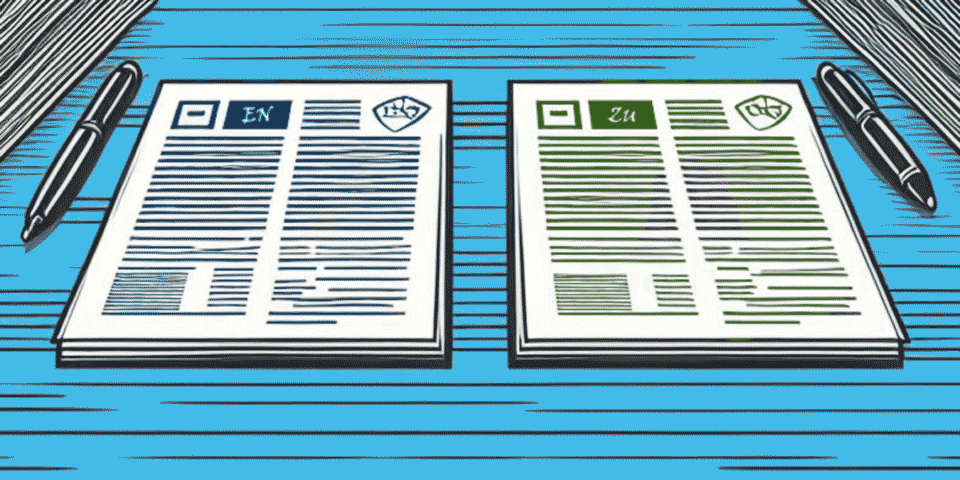
IsiZulu legal translations typically run 25% longer than the original text as they will offer explanations in accessible language for complex English legal terminology.
Government Document Translation Services
Government documents cover a broad range of materials, from strategic plans and policy guidelines to legislation and regulations. These documents guide decision-making processes and shape legal frameworks across all sectors. PAIA manuals, official documents and court documents are critical components of governmental operations, requiring precise translation to ensure clarity and compliance.
Documents: Strategic Plans, Policy Guidelines, Legislation, Regulations, PAIA.
PAIA (Promotion of Access to Information Act) Manuals
The Promotion of Access to Information Act (PAIA) is a cornerstone of South African democracy, providing the public with the right to access information held by both public and private bodies. A key requirement of the Act is that public and private bodies must compile and publish a PAIA Manual.
To ensure true accessibility and compliance with the spirit of the Act, these manuals must be available in all 11 official South African languages. We provide certified translation services for PAIA manuals, ensuring your document is not only accurate but also culturally and legally appropriate for all linguistic groups in South Africa. Our certified translations help you meet your legal obligations and build transparency with the public.
Business & Corporate Document Translation Services
Businesses depend on a wide range of documents to carry out their operations, manage relationships and ensure legal compliance. Accurate translation of business and corporate documents is essential for clear communication and adherence to legal standards. These documents include employment contracts, financial reports, fees policies, application forms, lease agreements and company manuals, among others.
Industry-Specific Document Translation Services
Certain industries require specialised documentation containing technical terminology and industry-specific regulations. Medical documents, such as clinical trial documents, demand precise translation to ensure patient safety and regulatory compliance. Similarly, environmental documents like EIAs and property agreements in industries such as mining require accurate translation to mitigate risks and ensure legal compliance.
Contract & Agreement Translation Services
Contracts and agreements form the backbone of legal relationships, outlining rights, obligations and terms of engagement between parties. Informed consent forms, joint submissions and contractual agreements require meticulous translation to uphold the integrity of legal arrangements and ensure clear communication between parties.
Additional Legal Document Translation Services
The legal landscape covers many document types that fall outside standard categories. From deed of trust amendments to plea bargain statements, accurate translation of these materials is essential. Legal correspondence including letters and emails, as well as workshop materials, require precise translation to ensure clear communication and legal compliance.
Request a Certified Legal Translation Quote
Our certified, first-language translators deliver precise legal translations for contracts, PAIA manuals, court documents and government publications in all 11 official South African languages. Email us at info@iitranslation.com and attach your documents for a personalised quote within five minutes (7:30am - 5pm SAST, Monday to Friday).
Frequently Asked Questions: Legal Translation Services
What legal documents do you translate?
Our legal translation work covers four broad categories. Government and regulatory documents include PAIA manuals, strategic plans, policy guidelines, legislation, regulations and court submissions. Business and corporate documents include employment contracts, fees policies, application forms, lease agreements, financial reports and company manuals. Industry-specific legal documents include medical informed consent forms, clinical trial contracts, mining compliance documentation and environmental impact agreements. Contracts and agreements include joint submissions, contractual agreements between parties and any document where precise rendering of rights and obligations is a legal requirement. We also handle miscellaneous legal documents that resist easy categorisation, including deed of trust amendments, plea bargain statements, legal correspondence and workshop materials. If the document has legal standing or will be used in a legal context, we can translate it.
What is the difference between a certified legal translation and a sworn translation?
This is one of the most commonly misunderstood distinctions in South African translation practice and it matters because the two are not equivalent. A sworn translation is a document signed before a Commissioner of Oaths, a legal formality that carries no quality guarantee whatsoever. Any individual can produce a sworn translation with no professional qualification, no subject-matter expertise and no obligation to proofread the result. A certified legal translation from iiTranslation is a fundamentally different document. Every translation is produced by a university-qualified first-language specialist with a minimum of 10 years' legal subject-matter experience, then passed through our ISO 17100:2015-compliant editorial process. Each delivery is accompanied by a certificate of translation that documents the translator's formal qualifications and the quality control checks applied, a certificate that can be submitted to a court, a regulator or a government department as evidence of compliance. For a detailed breakdown of the differences, see our comparison of certified, ISO-certified and sworn translations.
Why does a translated legal document need to preserve legal effect and not just meaning?
This is where legal translation diverges most sharply from general translation, and where the consequences of getting it wrong are most serious. In a contract, the precise wording of a clause determines what a party is obligated to do and what recourse exists if they do not. A translation that conveys the general meaning correctly but renders a conditional clause as an absolute one, or weakens the language of an indemnity, has changed the legal character of the document, regardless of how fluent it reads. Our legal translators are trained to identify and preserve the legal effect of every clause, not just its surface meaning. This requires understanding South African contract law, the conventions of legal drafting in each target language and the specific regulatory context the document operates in. It is a different discipline from translating a news article or a corporate brochure, and we staff it accordingly.
Is every private company legally required to have a PAIA manual translated?
Yes. The Promotion of Access to Information Act (PAIA) requires both public bodies and private companies above a certain threshold to compile and publish a PAIA manual. The Act's purpose is to give all South Africans the right to access information held by organisations that affect their interests, and that right is meaningless if the manual is only available in English. The spirit of the Act, confirmed in practice by how regulators and civil society treat PAIA compliance, is that manuals should be accessible to the communities an organisation operates in. For a company with operations in Limpopo, that means a Sepedi version. For one with a large Afrikaans-speaking workforce in the Western Cape, it means an Afrikaans version. For organisations operating nationally, isiZulu, isiXhosa, Setswana and Sesotho are typically required alongside the Western Cape languages. We translate PAIA manuals into all 11 official South African languages and can advise on which languages are appropriate for your specific operational footprint.
Why do translated legal documents sometimes end up longer than the original?
This is a practical reality of translating complex English legal text into many of the South African languages, and it has direct implications for document layout and formatting. English legal drafting is highly compressed. It relies on terms of art that carry precise meaning within a trained legal community. Many of these terms have no single-word equivalent in isiZulu, Sepedi or Xitsonga, and a responsible translator does not simply transliterate them. Instead they render the concept in accessible language that a lay reader in that community can understand, which typically requires more words. An isiZulu legal translation commonly runs 20 to 25% longer than the English source. For documents that will be typeset and printed, this must be factored into the design brief before translation begins. We flag this at the start of every project so that your design team can account for text expansion before layout is finalised, rather than after.
How do you handle the difference between legal accuracy and plain-language accessibility in the same document?
Many legal documents have to do two things at once: satisfy a precise legal standard and be understood by the person the document is addressed to. A PAIA manual must be legally compliant and readable by a member of the public with no legal training. A mining community's Social and Labour Plan must reflect commitments that can be enforced and be comprehensible to community members who will hold the company to those commitments. Our translators approach each document with a clear understanding of its primary purpose. Where the audience is legal professionals or a court, precision of legal effect takes absolute priority. Where the audience is a lay community, the translation is calibrated to the literacy level and language register of that community without sacrificing the legal substance. In some projects, particularly PAIA manuals and Social and Labour Plans, we produce both a legally precise full version and a plain-language summary in the same engagement. If your document requires this approach, please indicate it when you request a quote.
What does the certificate of translation include and when is it required?
Every legal translation we deliver is accompanied by a signed certificate of translation that documents four things: the translator's formal academic qualifications, their subject-matter experience, the quality control process applied to the document, including MS Word spelling and grammar checks in the target language, and confirmation that the translation was produced entirely by a human translator with no AI or LLM involvement at any stage. This certificate is the evidence that your translation was produced to a professional standard. It can be submitted to a regulatory authority such as an ethics committee reviewing clinical trial documentation, a tender adjudicator assessing a mining compliance submission or any other body requiring proof that translated documentation meets a defined quality standard. If you are unsure whether a certificate is needed for your specific submission, let us know when you request a quote and we will advise accordingly.
How long does a legal translation take and what does it cost?
We price all legal translation projects on a transparent per-word basis with no hidden fees. The figure in your quote is the final amount. Legal content attracts specialist rates reflecting the qualifications and experience level required, but we never charge premium fees for faster turnarounds. Our minimum project cost is R500 + VAT. Turnaround depends on document length, language combination and the availability of the specialist most appropriate for your content type. A single-page employment contract is a different scale of project from a full PAIA manual across five languages, and we plan accordingly. We provide a firm deadline only after the assigned translator has reviewed your files. Most clients receive a quote within 5 minutes of emailing their document during business hours. Please include the target language or languages and any submission deadline when you write so we can confirm availability immediately.
Clients