Certified English to Tshivenḓa Translation Services
At iiTranslation, we deliver accurate, culturally authentic English to Tshivenḓa (Venda) translations that meet rigorous quality standards. Our documents are professionally formatted to match your original copy, print-ready and delivered on schedule, with certified options available for legal or official requirements.
We combine linguistic precision with local cultural knowledge to handle legal contracts, CAPS-aligned educational resources and business communications with complete reliability. Every translation is verified by first-language Tshivenḓa specialists to ensure clarity and impact for clients across Gauteng and Vhembe District.
From Vhembe District municipal communications and Makhado school curricula to legal documentation for Gauteng firms, our translators understand the everyday contexts in which Tshivenḓa is used. This local knowledge ensures your documents carry the right register and terminology, whether your audience is a student in Thulamela or a legal professional in Johannesburg.
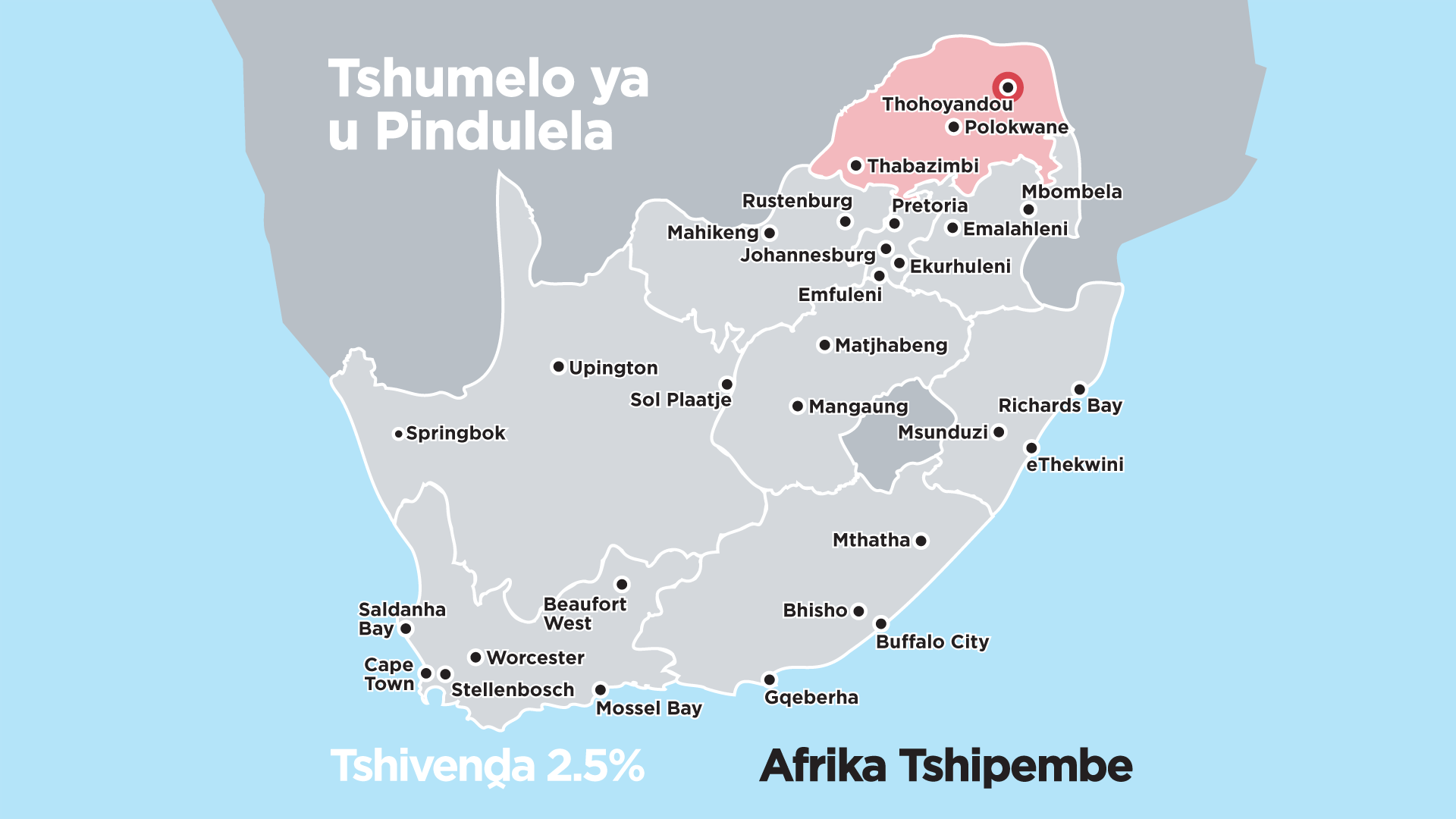
Tshivenḓa translation services serving Makhado and Thulamela communities in Vhembe District, plus clients throughout Gauteng.
Tshivenḓa Translation Services for Johannesburg, Pretoria & Thohoyandou
According to the 2022 South African Census, Tshivenḓa is South Africa's tenth largest home language, spoken by 2.5% of South Africans, an estimated 1,549,957 people. English is spoken by 8.7% of South Africans (5,388,221 people). In the Vhembe District of Limpopo where Tshivenḓa is most concentrated, English is not a competing language but a marginal one.
Tshivenḓa Translation Services in Johannesburg
Our translation services in Johannesburg reach 141,914 Tshivenḓa home speakers in the City of Johannesburg, the largest urban Tshivenḓa-speaking population outside Limpopo. For organisations with a Gauteng workforce that extends into Vhembe District operations, employment contracts, BCEA compliance documents and safety communications produced in Johannesburg often require certified Tshivenḓa translation. Unlike most South African official languages, Tshivenḓa is not mutually intelligible with its neighbours — a Tshivenḓa-speaking worker cannot be reached through Sepedi, Xitsonga or any other official language.
Tshivenḓa Translation Services in Pretoria
Our translation services in Pretoria reach 67,194 Tshivenḓa home speakers in Tshwane. National departments with regulatory, development or infrastructure responsibilities across the Vhembe District face a consistent requirement for certified Tshivenḓa translation in public communications, environmental notices and community consultation documents. Tshivenḓa's linguistic isolation means there is no approximation available: communities in Thulamela and Makhado must be addressed in their own language.
Tshivenḓa Translation Services in Thohoyandou
Thulamela municipality, which includes Thohoyandou and Sibasa, records 389,631 Tshivenḓa home speakers (63.0%) against just 4,329 English speakers (0.7%), a ratio of ninety to one. Makhado (Louis Trichardt) adds a further 347,289 speakers (67.3%) against 6,192 English (1.2%), and Musina a further 34,521 (50.5%). Across the Vhembe District, Tshivenḓa is not competing with English for reach — it is simply the language of the community. For organisations producing compliance documents, consultation materials or community communications for Limpopo's far north, certified Tshivenḓa translation reaches a linguistically distinct population that no other official language can substitute for.
Tshivenḓa Translation Services in Cape Town
Cape Town-based organisations with national operations that extend into Limpopo's Vhembe District require certified Tshivenḓa translation across a range of document types: environmental impact assessments, legal contracts, community consultation materials and educational content. Because Tshivenḓa is mutually unintelligible with every other official language, communities in Thulamela and Makhado must be addressed in their own language, regardless of what other translations an organisation has already commissioned. Our translation services in Cape Town handle Tshivenḓa as part of the multilingual compliance and communication requirements that Limpopo operations generate for Western Cape-based clients.
| Municipality (City) | Population | Tshivenḓa Speakers | % Tshivenḓa | English Speakers | % English |
|---|---|---|---|---|---|
| Thulamela (Thohoyandou, Sibasa) | 618,462 | 389,631 | 63.0% | 4,329 | 0.7% |
| Makhado (Louis Trichardt, Dzanani) | 516,031 | 347,289 | 67.3% | 6,192 | 1.2% |
| City of Johannesburg | 4,434,827 | 141,914 | 3.2% | 878,096 | 19.8% |
| City of Tshwane (Pretoria) | 2,921,488 | 67,194 | 2.3% | 245,405 | 8.4% |
| Musina | 68,359 | 34,521 | 50.5% | 2,939 | 4.3% |
Specialist Tshivenḓa Translation Services by Industry
Legal Document Translation
Certified Tshivenḓa legal translations for court documents, contracts and government publications. Our legal specialists ensure compliance and accuracy for clients in Pretoria's judicial system and nationwide requirements.
Educational Materials Translation
CAPS-aligned textbook and curriculum translations for schools in Vhembe District and across Limpopo. We translate educational content while maintaining pedagogical accuracy and cultural relevance for Tshivenḓa-speaking students.
Website Translation & Localisation
Certified website translation and Tshivenḓa localisation services for businesses targeting Gauteng and Limpopo markets. We ensure your digital content feels natural and culturally authentic to Tshivenḓa-speaking audiences while maintaining your brand voice.
For examples of our formal and technical translation capabilities, view our translated homepage Tshumelo ya u Pindulela ya Dzinyambo dza Afrika Tshipembe.
Get Your Certified Venda Translation Quote
Our certified translators deliver culturally precise Tshivenḓa translations for legal, educational and business documents across Vhembe District and Gauteng. Email info@iitranslation.com and attach your documents for a personalised quote within 5 minutes (7:30am - 5pm SAST).
Frequently Asked Questions: Tshivenḓa (Venda) Translation Services
How do you structure the costs for your Venda translation services?
As a specialist Tshivenḓa translation agency, we use a transparent per-word pricing model. This approach ensures total budgetary certainty, as the figure in your quote is the final amount you pay, with no hidden administration fees. Our rates for English to Venda and Tshivenḓa to English are determined per word and based on the technicality of the content, with a primary focus on legal contracts, educational materials and agricultural safety manuals. Our minimum project cost is R500 + VAT. We maintain a fixed-rate policy and do not charge premium rush fees for high-priority deadlines. Most corporate and government clients can expect to receive a formal quote within 5 minutes during our standard business hours.
What is the typical delivery timeframe for Tshivenḓa translation?
The delivery schedule is governed by the word count and the specific subject-matter expertise required for your project. We commit to a firm deadline only after a qualified native speaking linguist has reviewed your specific files. For time-sensitive requirements, urgent Venda translation with a 24-hour turnaround can be facilitated for pre-arranged tasks, such as urgent community notices or educational updates. If you are working against a strict deadline, please highlight this in your request for immediate confirmation of our capacity.
What is the difference between "Venda" and "Tshivenḓa" and can you handle the special characters?
While "Venda" is the high-volume term often used in search engines and casual conversation, Tshivenḓa is the grammatically correct name for the language. Critically, Tshivenḓa uses unique diacritics such as the ḓ, ḽ, ṋ and ṱ, which generic translation tools often corrupt or skip entirely. Our technical stack is specifically configured to handle these characters across all formats, including Adobe InDesign and tagged PDFs. This ensures that your translated content is orthographically perfect and respects the linguistic standards of the Vhembe District.
Do you provide certified or sworn Venda translation for legal documents?
Yes. We offer certified Tshivenḓa translation for legal contracts, court submissions, PAIA manuals and official tenders, produced by university-qualified Tshivenḓa linguists and passed through our ISO 17100:2015-compliant editorial process. It is important to note that because the South African government still only produces personal records (such as birth or marriage certificates) in English and Afrikaans, there is virtually no demand for sworn translations of these records into Tshivenḓa. Our expertise is centred on institutional and corporate documentation where legal compliance and linguistic precision are both required. View our legal translation expertise.
Does South Africa have official requirements for Tshivenḓa translations of government documents?
Yes. For institutional and official use, including Limpopo provincial government documents, Vhembe District municipal communications, PAIA manuals and agricultural development notices, a compliant Tshivenḓa translation must meet four core requirements. First, the translator must be a first-language Tshivenḓa speaker. Proficiency in the language is not sufficient for the formal register that regulatory documentation demands. Second, the linguist must hold an academic qualification in their home language, typically a university degree in Tshivenḓa linguistics or applied language studies. Third, the translator must have demonstrated subject-matter experience in the relevant field: a general linguist is not appropriate for a legal contract or a technical agricultural compliance document. Fourth, the translation must pass a quality control process that leaves the document in a print-ready state, meaning it has been run through an editing phase where it is proofread for readability and checked for consistency and any spelling or grammar errors that were missed in the primary translation. All four conditions are applied as standard on every project we accept.
Are your Tshivenḓa translations performed by native speakers and can AI accurately translate Tshivenḓa?
Every project is handled exclusively by native Tshivenḓa speakers with university degrees in linguistics and a minimum of 10 years of subject-matter experience. Our quality assurance process combines a primary translation phase by a subject-matter specialist with independent proofreading and our proprietary localised terminology checks. Because Tshivenḓa is not natively supported by MS Office proofing tools, we apply custom-built Tshivenḓa reference dictionaries in Microsoft Word to provide automated spelling and consistency verification. The result is output that is print-ready and orthographically precise, including the correct rendering of Tshivenḓa's unique diacritics (ḓ, ḽ, ṋ and ṱ) that generic tools routinely corrupt.
AI cannot meet this standard for Tshivenḓa. With fewer than 900 Wikipedia articles, Tshivenḓa is among the most data-scarce of all 11 official South African languages. AI models working with the language have almost no high-quality training material to learn from. The practical consequences are consistent: hallucinated vocabulary, borrowed terminology from related languages like Sepedi and Xitsonga, and systematic failures on the tonal and morphological structures Tshivenḓa requires. The language's unique diacritics present an additional problem: AI output frequently drops or corrupts them, producing text that is not only grammatically wrong but orthographically unacceptable to any literate Tshivenḓa reader. Using AI output as a draft for a human to correct is not a shortcut. It takes longer and costs more than translating from the source.
To see the scale of the digital gap for Tshivenḓa in context, view the data comparing South African language availability for AI training on our dedicated FAQ page.
Is your Tshivenḓa translation service standardised for educational and government use?
Yes. Although Tshivenḓa is one of South Africa's smaller official languages, it is highly standardised by Parliament for legal documentation and by the Department of Basic Education for the school curriculum. Our linguists provide a formal, standardised register that is effective across the Makhado and Thohoyandou corridor. This avoids any dialectal variations and ensures your message is universally understood in academic settings, including materials for higher education institutions.
Do you specialise in agricultural translation for the Vhembe region?
As the "Garden of South Africa," the Vhembe District has a high demand for agricultural translation. We provide specialised Tshivenḓa translation for irrigation technical sheets, fruit export safety manuals and agricultural development guides. Our translators ensure that technical farming terminology is accurately conveyed to local workforces while maintaining the standardised register required for professional compliance.
How do you ensure the privacy of sensitive Venda documentation?
We maintain a strict zero-sharing policy: your files are never uploaded to external AI platforms or public translation clouds. All Tshivenḓa projects are handled entirely within our secure infrastructure and accessed only by the specific native linguist assigned to your file. Every member of our network is bound by a comprehensive non-disclosure agreement. This level of security is fundamental for confidential legal contracts, HR records and commercially sensitive academic research. Full details are available in our Privacy Policy. We are always happy to sign NDAs if your organisation requires further assurance.
Which technical formats and adjacent languages do you support?
We work directly with designers who use Adobe InDesign, well-structured PDFs and dev teams with HTML, XML and CSV to ensure your digital and print assets are ready for immediate deployment. Because Tshivenḓa is geographically adjacent to other northern languages, we often manage multi-language projects that include Sepedi and Xitsonga. We treat each as a unique linguistic task, using dedicated native experts for each to ensure absolute precision across the Limpopo Province.
What is the difference between Tshivenḓa translation, interpreting and transcription?
For clients new to commissioning Tshivenḓa language work, the distinction between these three services is worth establishing clearly. Translation is the written conversion of a document from one language to another, a careful quality-controlled process that produces text fit for official submission, publication or community distribution. This is the only service we provide. Interpreting is the live oral facilitation of spoken communication, at a Vhembe District agricultural community meeting, a Limpopo government public participation session or a disciplinary hearing in Thohoyandou, for example. Transcription is the conversion of recorded audio or video into accurate written Tshivenḓa text, commonly required for stakeholder engagement recordings, focus groups or interviews that need to be archived or submitted in written form. Each is a distinct professional discipline. iiTranslation focuses entirely on professional written translation.
Clients