Certified English to Siswati Translation Services for Legal, Business and Education
As an official language of both South Africa and Eswatini, Siswati (often referred to by English speakers as Swati or Swazi) is spoken by over 2.9 million people combined, with 55% of Mpumalanga's Ehlanzeni District using it as their first language. At iiTranslation, we specialise in three key sectors where precise Siswati translations make the greatest impact: legally binding contracts for government offices in Mbombela, business communications for Eswatini enterprises and CAPS-aligned educational materials for schools across the region.
Our certified English to Siswati translators combine formal linguistic training with deep cultural knowledge of dialects in Mpumalanga and Eswatini. Whether you need court documents certified for the Mbombela High Court, employee handbooks for Nelspruit businesses or mathematics textbooks for Ehlanzeni classrooms, we ensure every translation meets strict quality benchmarks while maintaining the nuance of authentic Siswati communication.
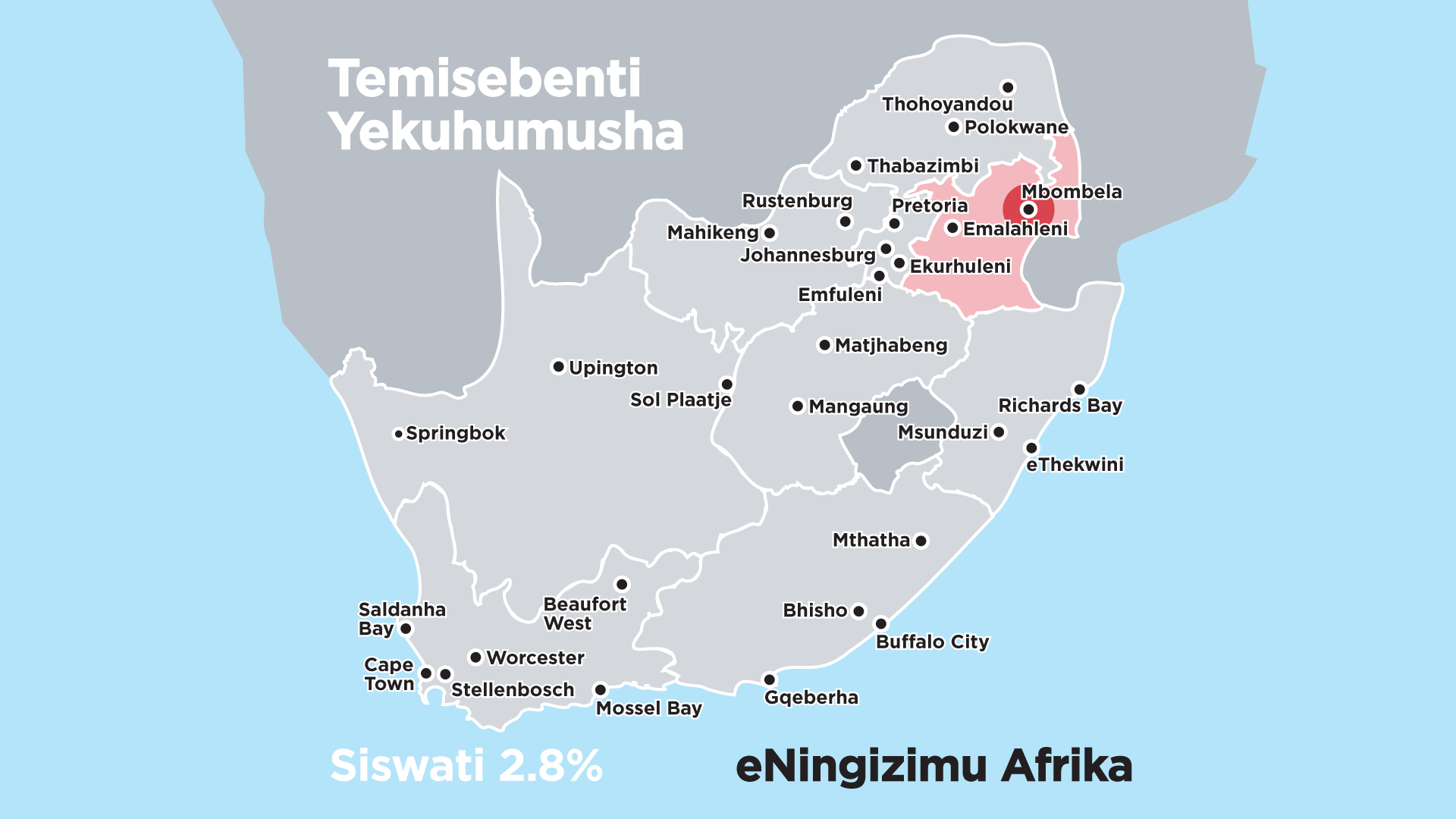
Siswati serves over 30% of Mpumalanga's population and is the national language of Eswatini, spoken by 2.9 million people across both nations.
Siswati Translation Services for Johannesburg, Pretoria & Mbombela
According to the 2022 South African Census, Siswati is South Africa's ninth largest home language, spoken by 2.8% of South Africans, an estimated 1,737,722 people. English is spoken by 8.7% of South Africans (5,388,221 people). In the communities where Siswati is most spoken, it outstrips English by margins that make English-only content largely ineffective.
Siswati Translation Services in Johannesburg
Our translation services in Johannesburg reach 35,479 Siswati home speakers in the City of Johannesburg, with Ekurhuleni adding a further 44,499. While these figures represent a modest share of each city's total population, they form a meaningful urban workforce audience for organisations whose Siswati-language obligations extend from Mpumalanga operations into Gauteng employment contracts and BCEA compliance documents.
Siswati Translation Services in Pretoria
Our translation services in Pretoria reach 43,822 Siswati home speakers in Tshwane. National departments with policy or regulatory responsibilities across Mpumalanga face a consistent requirement for certified Siswati translation in public communications, environmental notices and community-facing compliance materials produced from the administrative capital.
Siswati Translation Services in Mbombela
Mbombela (Nelspruit) has the largest absolute Siswati-speaking population of any city in South Africa, with 456,904 home speakers (77.6%) against just 27,085 English speakers (4.6%). The surrounding region is even more pronounced: Nkomazi records 345,866 Siswati speakers (88.0%) against 4,323 English (1.1%), a ratio of 80 to one, and Albert Luthuli returns 106,026 speakers (57.0%) against 3,720 English (2.0%). For organisations producing compliance documents, community communications or environmental consultation materials for Mpumalanga audiences, certified Siswati translation reaches communities where English-only content is largely ineffective.
Siswati Translation Services in Cape Town
Siswati is the only South African official language that is also the national language of a sovereign neighbouring state. Eswatini shares a long border with Mpumalanga, and companies with cross-border sourcing, manufacturing or investment in Eswatini require certified Siswati translation for commercial contracts, employment documentation and regulatory submissions on both sides of the border. Several holding companies and multinationals with Eswatini exposure maintain head offices or legal counsel in Cape Town. Our translation services in Cape Town support these clients with certified Siswati translation that meets the requirements of both South African and Eswatini legal and regulatory frameworks.
| Municipality (City) | Population | Siswati Speakers | % Siswati | English Speakers | % English |
|---|---|---|---|---|---|
| Mbombela (Nelspruit) | 588,794 | 456,904 | 77.6% | 27,085 | 4.6% |
| Nkomazi | 393,030 | 345,866 | 88.0% | 4,323 | 1.1% |
| Albert Luthuli | 186,010 | 106,026 | 57.0% | 3,720 | 2.0% |
| Ekurhuleni (East Rand) | 3,178,470 | 44,499 | 1.4% | 378,238 | 11.9% |
| City of Tshwane (Pretoria) | 2,921,488 | 43,822 | 1.5% | 245,405 | 8.4% |
| City of Johannesburg | 4,434,827 | 35,479 | 0.8% | 878,096 | 19.8% |
Siswati: South Africa and Eswatini's Shared Language
As South Africa's 9th most-spoken language with 1.7 million first-language speakers, Siswati connects two nations. In Mpumalanga's Ehlanzeni District, home to 55% of the province's Siswati speakers and across Eswatini's 1.2 million speakers, the language shapes legal, educational and cross-border business communication.
Recognised as an official language in both countries, Siswati requires translators who understand its dual context. Our certified team handles linguistic nuances from Mbombela courtrooms to Mbabane boardrooms, ensuring consistency for documents used in either jurisdiction.
Specialist Siswati Translation Services
We deliver authentic professional written Siswati translations for Mpumalanga schools, Eswatini businesses and cross-border legal matters. Here is what sets our expertise apart:
- Educational Expertise: We translate CAPS-aligned textbooks, exams and parent communications for Ehlanzeni District schools, using terminology approved by Mpumalanga's Department of Education.
- Mining & Environmental Compliance: We provide certified mining translation services for Social and Labour Plans (SLPs) and safety protocols, ensuring technical accuracy for the Mpumalanga mining sector.
- Legal Precision: Our certified legal translation services handle court documents, contracts and government policies for clients in Mbombela and Mbabane, meeting the standards of organs of state.
- Rigorous Quality & Spelling Checks: Every Siswati translation undergoes the same MS Word spelling and proofing checks as your English documents. Our custom dictionaries ensure linguistic accuracy that many other providers cannot match.
- Cultural Authenticity: Our first-language linguists ensure natural phrasing and local dialect accuracy, distinguishing between formal Siswati and regional usage.
- Complete Transparency: We provide translator qualifications and methodology documentation, essential for school districts and legal firms requiring certified translations.
Siswati Digital Translation and Localisation Services
Siswati offers unique cross-border digital reach, connecting audiences in both South Africa and Eswatini. This presents opportunities for regional campaigns, educational platforms and business communications that land authentically across national boundaries while maintaining cultural authenticity.
To see our full cross-border capabilities, explore our website localisation services or view Imisebenti Yekuhumusha yeTilwimi taseNingizimu Afrika, our Siswati-translated homepage showcasing formal and technical language translation.
Get Your Certified Siswati Translation Quote
Our certified translators deliver culturally precise Siswati translations for legal, business and educational documents across Mpumalanga and Eswatini. Email info@iitranslation.com and attach your documents for a personalised quote within 5 minutes (7:30am - 5pm SAST).
Frequently Asked Questions: Siswati Translation Services
How are Siswati translation rates and project costs calculated?
As a specialist Siswati translation agency, we work on a straightforward per-word rate with no hidden surcharges. The figure in your quote is the final amount you pay. Pricing for English to Siswati and Siswati to English is determined by document volume and technical complexity, particularly for legal contracts, mining compliance documents and educational materials requiring curriculum-specific terminology. Our minimum project cost is R500 + VAT. We apply a flat rate across all projects and do not charge premium fees for urgent turnarounds. Most government departments, Mpumalanga schools and corporate clients receive a firm quote within 5 minutes during business hours.
What is the typical turnaround for professional Siswati translation?
Delivery timelines depend on document length and the availability of the specialist linguist best suited to your content. We confirm a firm deadline only after the assigned translator has reviewed your files. When we commit to a date, we meet it. For high-priority work, urgent Siswati translation with a 24-hour turnaround is available by prior arrangement, covering everything from Social and Labour Plan (SLP) addenda to time-sensitive community engagement notices in Mpumalanga. If your deadline is fixed, state it in your inquiry and we will confirm availability immediately.
Do you provide certified Siswati translation for legal and official documents?
Yes. We provide certified Siswati translation for legal contracts, court documents, PAIA manuals, employment agreements and government tenders, produced by university-qualified Siswati linguists and passed through our ISO 17100:2015-compliant editorial process. As with most South African languages, the government does not issue personal records such as birth or marriage certificates in Siswati, so demand for sworn translations of personal documents is effectively non-existent. Our focus is on institutional and technical documentation. A notable advantage of Siswati is that the language is identical in South Africa and Eswatini, unlike Sesotho or Setswana, which differ orthographically across borders. A certified translation produced for a South African client is equally valid for an Eswatini audience, with no adaptation required. View our legal translation services.
Does South Africa have official requirements for Siswati translations of government documents?
Yes. For institutional and official use, including Mpumalanga provincial government documents, mining sector compliance materials, PAIA manuals and Social and Labour Plans, a compliant Siswati translation must satisfy four core requirements. First, the translator must be a first-language Siswati speaker. Working knowledge of the language is not sufficient for the formal register that regulatory documentation demands. Second, the linguist must hold an academic qualification in their home language, typically a university degree in Siswati linguistics or applied language studies. Third, the translator must have demonstrated subject-matter experience in the relevant field: a linguist qualified in educational translation is not the appropriate choice for a mining safety procedure or a clinical research document. Fourth, the translation must pass a quality control process that leaves the document in a print-ready state, meaning it has been run through an editing phase where it is proofread for readability and checked for consistency and any spelling or grammar errors that were missed in the primary translation. All four conditions are applied as standard on every project we accept.
Are your Siswati translations performed by native speakers — and can AI accurately translate Siswati?
Every project is handled exclusively by native Siswati speakers with university degrees in linguistics and a minimum of 10 years of subject-matter experience. Our quality assurance process combines a primary translation phase by a subject-matter specialist with independent proofreading and our proprietary localised terminology checks. We also apply custom Siswati dictionaries in Microsoft Word for spelling and consistency verification, because unlike Sepedi and Setswana, Siswati is not natively supported by MS Office proofing tools and we have built our own reference sets to compensate. The result is output that is print-ready to a standard that off-the-shelf tools alone cannot guarantee.
AI is not a workable alternative for Siswati, and using it as a first draft is a false economy. A qualified linguist reviewing AI-generated Siswati will encounter errors at every level: word choice, sentence structure, register and terminology. What looks like a proofreading task is in practice a reconstruction job, cross-referenced against a flawed source. It takes longer and costs more than translating from scratch.
The underlying problem is data scarcity. With approximately 2.9 million speakers across South Africa and Eswatini, Siswati simply does not have the volume of published written text that AI models require to develop reliable competence. Unlike Sesotho or Setswana, there is no cross-border variant contamination problem, the language is the same in both countries, but this does not help: there is just not enough high-quality Siswati text in existence for the models to learn from. The result is hallucinated vocabulary, borrowings from related Nguni languages like isiZulu and consistent failures on the concord rules and morphology the language requires. This is a data problem shared across Siswati, Xitsonga, Tshivenḓa and Southern isiNdebele and it is not resolved by more careful prompting.
To see the scale of the digital gap for Siswati in context, view the data comparing South African language availability for AI training on our dedicated FAQ page.
Is Siswati the same in South Africa and Eswatini?
Yes, and this is an important distinction from most other cross-border African languages. Unlike Sesotho, which uses a different orthography in Lesotho or Setswana, which has distinct South African and Botswana variants recognised as separate in professional proofing software, Siswati is orthographically and grammatically identical across both countries. A document translated to the standard required for a Mbombela courtroom or an Ehlanzeni District school is equally appropriate for an audience in Mbabane. This makes Siswati particularly cost-efficient for organisations operating across both jurisdictions: one translation, no adaptation. Our linguists are familiar with both the South African institutional context and the cross-border business environment, ensuring your content is professionally resonant wherever your audience is.
How do you protect the confidentiality of Siswati documents?
We operate under a strict zero-sharing policy: your files are never processed through third-party AI platforms or stored in external translation clouds. All content remains within the iiTranslation network, accessible only to the linguist assigned to your project, who is bound by a formal non-disclosure agreement as a standard condition of engagement. This is particularly important for mining compliance documentation, confidential HR records and legally sensitive business content. Full details of our security protocols are set out in our Privacy Policy. We are always willing to sign NDAs if your organisation requires further assurance.
What document types and related languages do you support?
We handle a wide range of written content for South African organisations, including legal documents (contracts, PAIA manuals, court submissions), medical and clinical materials (informed consent forms, participant information leaflets), mining documentation (Social and Labour Plans, safety procedures), CAPS-aligned educational materials (textbooks, curriculum content, assessment papers) and digital content (website localisation, software interfaces, e-learning modules). For technical and web projects we work directly in HTML, XML and CSV formats. As specialists in South African languages, we regularly manage multi-language campaigns that pair Siswati with its Nguni relatives, isiZulu, isiXhosa and Southern isiNdebele, for organisations requiring comprehensive reach across the eastern provinces.
What is the difference between Siswati translation, interpreting and transcription?
For clients new to commissioning Siswati language work, these three services are worth distinguishing clearly. Translation is the written conversion of a document from one language to another, a careful quality-controlled process producing text fit for legal submission, official publication or institutional distribution. Written translation is the only service we provide. Interpreting is the live oral facilitation of spoken communication, at a mine induction in Mpumalanga, a community consultation in the Ehlanzeni District or a disciplinary hearing in Mbombela, for example. Transcription converts recorded audio or video into accurate written text, commonly required for stakeholder engagement recordings, focus group sessions or interviews that need to be archived or submitted in written form. iiTranslation focuses entirely on professional written translation.
Clients