Certified English to Xitsonga Translation Services
As South Africa's eighth most-spoken language, Xitsonga is spoken by over 2.9 million people, with strong presence in Limpopo's government sectors and Pretoria's growing Xitsonga-speaking communities. Our certified English to Xitsonga translators specialise in legal, educational and environmental documents that serve these regions with cultural precision.
From school textbooks in Giyani to legal contracts for Johannesburg firms, we ensure every translation meets the highest standards while remaining true to Xitsonga's linguistic nuances. Our work supports clear communication for environmental projects, municipal offices and community initiatives across Limpopo and Gauteng.
Xitsonga is the home language of 17.3% of Limpopo residents and 10.6% in Mpumalanga, dwarfing English at 1% and 1.5% respectively. For organisations delivering services, running compliance processes or communicating policy in these provinces, translating into Xitsonga isn't a courtesy, it's a practical necessity. Our translators are based in these communities and understand the regional and dialectal differences that matter on the ground.
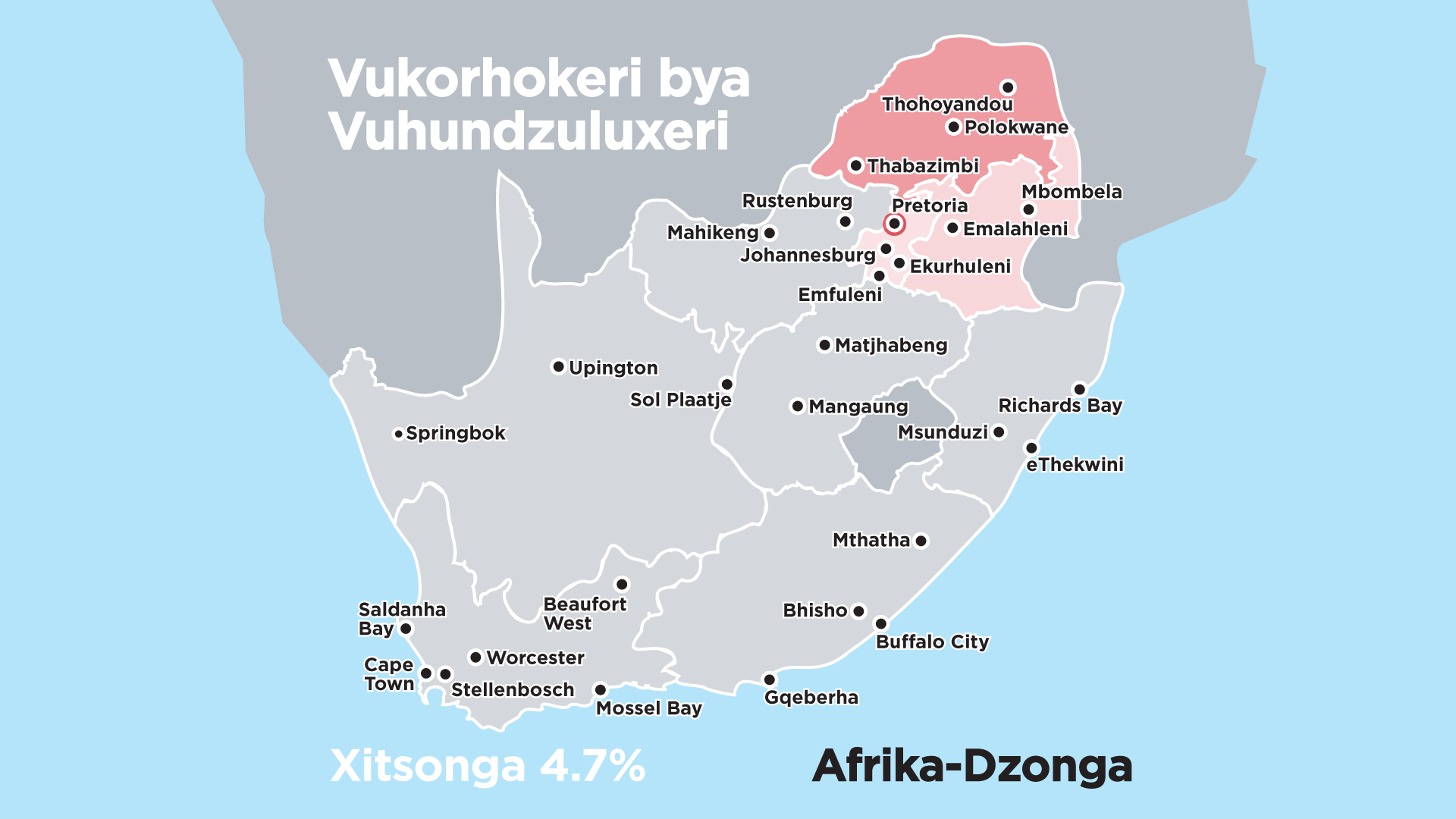
Xitsonga translations serve communities across Limpopo including Giyani, Malamulele and Tzaneen, as well as growing populations in Pretoria and Johannesburg.
Xitsonga Translation Services for Johannesburg, Pretoria & Giyani
According to the 2022 South African Census, Xitsonga is South Africa's eighth largest home language, spoken by 4.7% of South Africans, an estimated 2,913,111 people. English is spoken by 8.7% of South Africans (5,388,221 people). In the communities where Xitsonga is most spoken, it does not merely outpace English — it renders English an almost invisible presence.
Xitsonga Translation Services in Johannesburg
Our translation services in Johannesburg reach 288,264 Xitsonga home speakers in the City of Johannesburg, with Ekurhuleni adding a further 209,779 to bring the combined figure to nearly 500,000 speakers across Johannesburg and the East Rand. For any organisation with a Gauteng customer base or workforce that extends into Limpopo and Mpumalanga, Xitsonga translation reaches a significant urban audience that English-only communications do not address.
Xitsonga Translation Services in Pretoria
Our translation services in Pretoria reach 245,405 Xitsonga home speakers in Tshwane, exactly equal in number to the English-speaking population in the same city. National departments and public entities headquartered in Pretoria with policy responsibilities for Limpopo and Mpumalanga face a consistent requirement for certified Xitsonga translation in public communications, environmental documentation and community-facing compliance materials.
Xitsonga Translation Services in Giyani
Giyani is the administrative centre of Limpopo's Mopani District and the heartland of Xitsonga-speaking South Africa. Across the surrounding region, English is effectively absent as a home language. Bushbuckridge records 307,429 Xitsonga home speakers (56.8%) against just 3,789 English speakers (0.7%), a ratio of more than 81 to one. Greater Tzaneen returns 159,159 speakers (40.8%) against 6,242 English (1.6%) and Makhado 113,011 speakers at a ratio of 18 to one. Thulamela (Thohoyandou) records a further 201,000 Xitsonga speakers (32.5%). For organisations producing compliance documents, community communications or consultation materials for Limpopo and Mpumalanga audiences, certified Xitsonga translation reaches communities where no other official language comes close to matching its geographic concentration.
Xitsonga Translation Services in Cape Town
Limpopo is South Africa's primary fruit and vegetable producing province, and several of the agribusinesses, food retailers and export traders that source from the region maintain head offices or procurement operations in Cape Town. Employment contracts, BCEA compliance documents and community liaison materials produced at head office level often require certified Xitsonga translation before they reach workers and growers on the ground. Our translation services in Cape Town support this workflow, handling Xitsonga as part of the multilingual compliance requirements that Limpopo agricultural operations generate for Western Cape-based clients.
| Municipality (City) | Population | Xitsonga Speakers | % Xitsonga | English Speakers | % English |
|---|---|---|---|---|---|
| Bushbuckridge | 541,248 | 307,429 | 56.8% | 3,789 | 0.7% |
| City of Johannesburg | 4,434,827 | 288,264 | 6.5% | 878,096 | 19.8% |
| City of Tshwane (Pretoria) | 2,921,488 | 245,405 | 8.4% | 245,405 | 8.4% |
| Ekurhuleni (East Rand) | 3,178,470 | 209,779 | 6.6% | 378,238 | 11.9% |
| Thulamela (Thohoyandou) | 618,462 | 201,000 | 32.5% | 4,329 | 0.7% |
| Greater Tzaneen | 390,095 | 159,159 | 40.8% | 6,242 | 1.6% |
| Makhado | 516,031 | 113,011 | 21.9% | 6,192 | 1.2% |
Specialist Xitsonga Translation Services by Industry
Our certified translators combine linguistic precision from the Xitsonga Lexicographic Unit's Tihlungu ta Rixaka dictionary with modern language trends. We deliver certified written translations that are technically accurate and culturally appropriate for Limpopo and Gauteng's 2.9 million Xitsonga speakers. Note that while we primarily use the formal term Xitsonga, this covers Tsonga and Shangaan and we support the full breadth of the linguistic community.
Certified Legal Xitsonga Translations
For contracts, court filings and official government documents, our professional legal translation services deliver meticulous precision. Our translators bring 10+ years of experience in South African legal terminology, ensuring all documentation is compliant with the requirements of organs of state and local judicial systems.
Educational Translations for Limpopo Districts
We translate CAPS-aligned textbooks, including learner books and teacher guides, for schools in Giyani and across the Limpopo province. Our education specialists prioritise pedagogical accuracy, ensuring complex concepts are accessible within the Xitsonga-speaking learner's specific vocabulary and cultural context.
Xitsonga Environmental & Mining Translations
Our linguists prepare technical environmental impact assessments (EIAs), resource management plans and compliance reports for projects in Limpopo and Mpumalanga. We translate complex regulatory language into and clear written Xitsonga communication for stakeholders near protected areas and industrial sites.
Specialising in the regional extractive industries, we provide professional mining translation services for Social and Labour Plans (SLPs), safety protocols and community engagement documents. We ensure that technical mining terminology is translated with meticulous precision to meet DMR standards and facilitate clear communication with local Xitsonga-speaking communities.
Get Your Certified Xitsonga Translation Quote
We are South Africa's trusted partner for certified Xitsonga communication. Our certified translators deliver culturally precise translations for legal, educational and environmental documents across Limpopo and Gauteng. Email info@iitranslation.com and attach your documents for a personalised quote within 5 minutes (7:30am - 5pm SAST).
Frequently Asked Questions: Xitsonga Translation Services
How do you calculate the costs for Xitsonga translation projects?
As a specialist Xitsonga translation agency, we use a transparent per-word rate structure. This provides our clients with complete budgetary certainty: the total in your quote is the final amount due, with no hidden administration fees or surcharges. Our pricing for English to Xitsonga and Xitsonga to English is determined by the technical complexity of the content, including Environmental Impact Assessments (EIAs), legal contracts and mining safety notices. Our minimum project cost is R500 + VAT. We offer flat-rate pricing for all projects and do not levy premium fees for high-priority turnarounds. Most government departments and NGOs receive a formal quote within 5 minutes during business hours.
What is the typical lead time for professional Xitsonga translation?
Delivery windows are determined by the document's length and the availability of a first-language linguist specialising in your sector. We provide a firm delivery commitment only after our translators have assessed the material. For time-critical requirements, urgent Xitsonga translation with a 24-hour turnaround can be facilitated by prior arrangement, particularly for community notices or urgent environmental reports. If you are facing a non-negotiable deadline, please highlight this in your inquiry for immediate scheduling confirmation.
Do you offer certified or sworn Xitsonga translation for official use?
Yes. We provide certified Xitsonga translation for official tenders, court documents, PAIA manuals and legal contracts, produced by university-qualified Xitsonga linguists and passed through our ISO 17100:2015-compliant editorial process. It is worth noting that since the South African government does not issue personal records such as birth or marriage certificates in Xitsonga, the demand for sworn translations for personal use is virtually non-existent. Our focus is on institutional and corporate documentation where legal compliance and linguistic precision are both required. View our legal translation services.
Does South Africa have official requirements for Xitsonga translations of government documents?
Yes. For institutional and official use, including Limpopo and Mpumalanga provincial government documents, Environmental Impact Assessment (EIA) public participation notices, PAIA manuals and Social and Labour Plans, a compliant Xitsonga translation must meet four core requirements. First, the translator must be a first-language Xitsonga speaker. The formal register of regulatory documentation is a distinct discipline from everyday fluency. Second, the linguist must hold an academic qualification in their home language, typically a university degree in Xitsonga linguistics. Third, the translator must have demonstrated subject-matter experience in the relevant field: a linguist specialising in environmental communication is not interchangeable with one qualified in mining compliance or clinical research. Fourth, the translation must pass a quality control process that leaves the document in a print-ready state, meaning it has been run through an editing phase where it is proofread for readability and checked for consistency and any spelling or grammar errors that were missed in the primary translation. All four conditions are applied as standard on every project we accept.
Are your Xitsonga translations performed by native speakers — and can AI accurately translate Xitsonga?
Every assignment is managed exclusively by native Xitsonga speakers with university degrees in linguistics and a minimum of 10 years of professional experience. Our internal quality cycle includes primary translation by a subject-matter expert, followed by independent proofreading and our proprietary localised terminology checks. This human-only approach ensures that the final output is print-ready and culturally resonant, whether it is for a Giyani-based mining operation or a public health campaign in Limpopo Province. Explore our healthcare translation services.
AI cannot serve as a reliable starting point for Xitsonga and treating it as one creates more work rather than less. A qualified linguist reviewing AI-generated Xitsonga will find errors embedded throughout the text at every level: vocabulary, sentence structure, register and terminology. They are not editing. They are reconstructing from a compromised source while tracking what the original document actually said. This is consistently slower and more expensive than translating directly from the source text.
Xitsonga is among the most data-scarce of all eleven South African official languages. There is simply not enough high-quality published Xitsonga text for AI models to have developed reliable competence in the language. This is compounded by a cross-border contamination problem: AI training data draws on Tsonga material from Mozambique and Zimbabwe as well as South Africa and these variants use different orthographic conventions. The result is output that blends incompatible spelling systems unpredictably. Beyond the orthographic problem, the models hallucinate, borrow from neighbouring languages like Sepedi and Tshivenḓa and fail consistently on the grammatical structures Xitsonga requires. Like Sesotho, Xitsonga has no Microsoft Word proofing integration, so there is no automated fallback. This data scarcity problem is shared across Xitsonga, Siswati, Tshivenḓa and Southern isiNdebele and it is not resolved by more sophisticated prompting.
To see the scale of the digital gap for Xitsonga in context, view the data comparing South African language availability for AI training on our dedicated FAQ page.
What is the difference between Xitsonga and Shangaan translation?
While the terms are often used interchangeably in casual conversation, Xitsonga is the official name of the language as recognised by the South African Constitution. "Shangaan" typically refers to a specific dialectal and ethnic group within the broader Tsonga-speaking community. Our professional Xitsonga linguists work in the standardised formal register required for official Limpopo and Gauteng business communication, ensuring your documents are authoritative and culturally appropriate for audiences across Giyani, Bushbuckridge and the Kruger National Park regions.
Do you specialise in environmental and wildlife conservation translation?
Yes. Xitsonga is a vital language for stakeholders in the Eastern Mpumalanga and Limpopo regions bordering the Kruger National Park. We regularly handle environmental conservation materials, community engagement documentation and agricultural development manuals. Our translators are experienced at conveying complex scientific and environmental concepts accessibly for Xitsonga-speaking communities, making us the preferred choice for EIA practitioners and environmental NGOs operating in the northern provinces.
How do you maintain the confidentiality of sensitive Xitsonga documents?
We enforce a strict zero-sharing policy for all client files. Your documents are never processed through third-party AI engines or stored in public translation clouds. All content remains within the iiTranslation network and is only accessible by the linguist assigned to your project, who is bound by a formal non-disclosure agreement as a condition of engagement. This level of security is essential for confidential mining notices, HR records and commercially sensitive business reports. You can review our full security protocols in our Privacy Policy. We are always happy to sign NDAs if your organisation requires further assurance.
What digital formats and related languages do you support?
We work directly in Adobe InDesign, well-structured PDFs, HTML, XML and CSV and can collaborate with your design team to ensure technical and digital assets are ready for deployment without formatting loss. As South African language specialists, we regularly manage multi-language projects that include Xitsonga alongside Sepedi and Tshivenḓa. While these languages are geographically adjacent in the northern provinces, they are entirely linguistically distinct. We assign dedicated native-speaker experts to each to ensure absolute precision across all document types.
What is the difference between Xitsonga translation, interpreting and transcription?
These three services are frequently treated as interchangeable, especially by organisations commissioning Xitsonga language work for the first time in connection with EIA or community consultation obligations. Translation is the written conversion of a document from one language to another, a careful quality-controlled process producing text suitable for official submission, legal compliance or public distribution. This is the only service we provide. Interpreting is the live oral facilitation of spoken communication, at an EIA public participation meeting, a conservation community consultation or a disciplinary proceeding in Giyani or Bushbuckridge, for example. Transcription is the conversion of recorded audio or video into accurate written Xitsonga text, commonly required for community engagement recordings, focus group sessions or stakeholder interviews that must be archived or submitted in written form. Each is a distinct professional discipline. iiTranslation focuses entirely on professional written translation.
Clients