Certified English to Sesotho Translation Services
At iiTranslation, we deliver culturally precise English to Sesotho translations that meet strict quality standards. Our documents are print-ready, professionally formatted and delivered on time, with certification available for legal or official use.
We combine linguistic expertise with deep cultural understanding to handle legal documents, healthcare materials and educational resources with meticulous accuracy. Every translation is reviewed by first-language Sesotho speakers to ensure your message resonates clearly with audiences in Johannesburg, Bloemfontein and the Free State.
From Free State government departments and Mangaung municipal communications to healthcare providers serving Matjhabeng's mining communities, our translators understand the everyday contexts in which Sesotho is used. This sector knowledge ensures your documents carry the right register and terminology, whether your audience is a student in the Free State or a lawyer in Johannesburg.
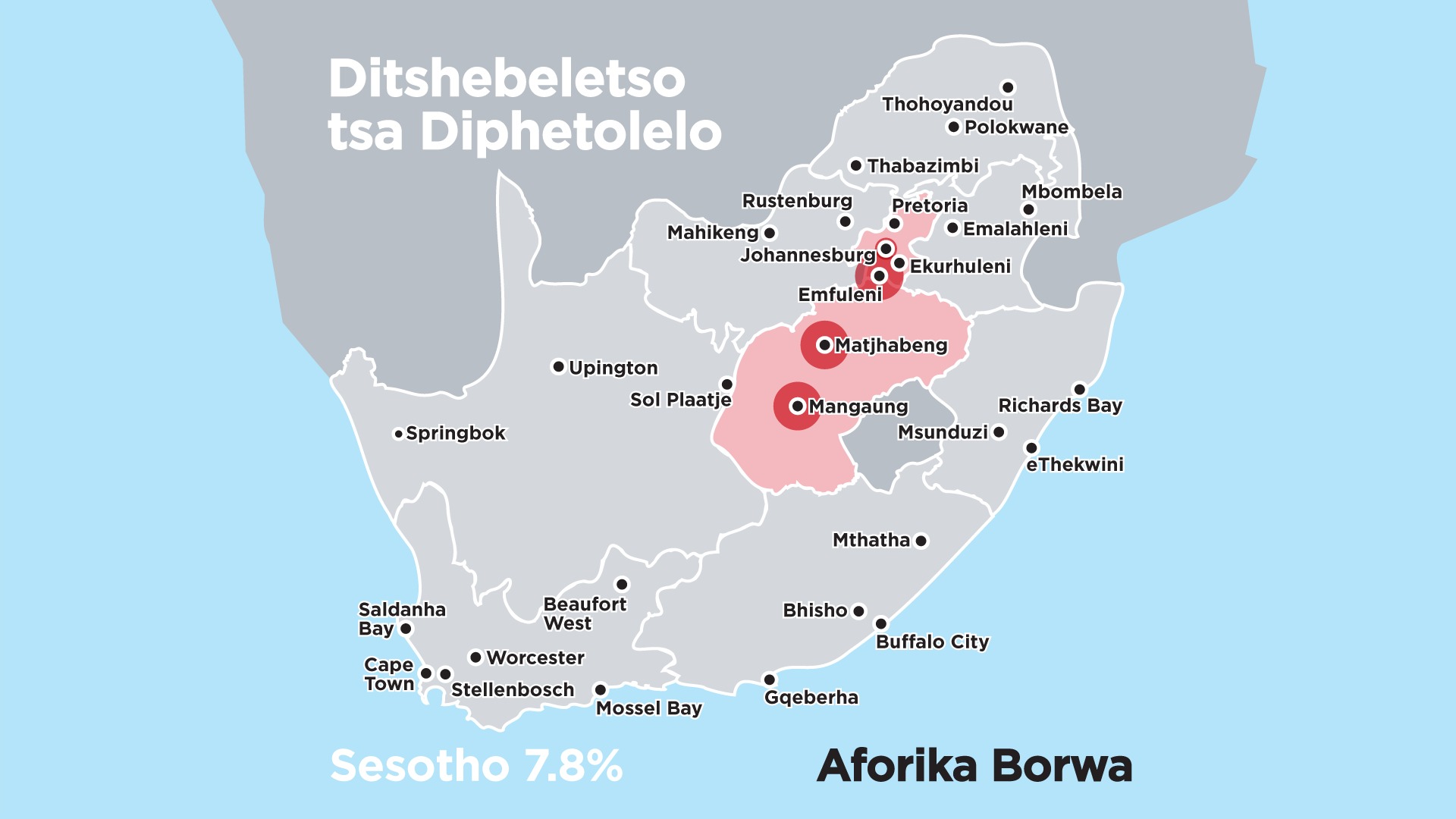
Sesotho is spoken by 72.3% of Free State residents and 13.1% of Gauteng's population, with strong presence in Mangaung, Matjhabeng and Johannesburg.
Sesotho Translation Services for Johannesburg, Bloemfontein & Pretoria
According to the 2022 South African Census, Sesotho is South Africa's seventh largest home language, spoken by 7.8% of South Africans, an estimated 4,958,852 people. English is spoken by 8.7% of South Africans (5,388,221 people).
Sesotho Translation Services in Johannesburg
Our translation services in Johannesburg reach 421,309 Sesotho home speakers in the City of Johannesburg, with Ekurhuleni adding a further 314,669 to bring the combined figure to nearly 736,000 speakers across Johannesburg and the East Rand. Emfuleni (Vereeniging), on Johannesburg's southern border, adds a further 375,265 Sesotho speakers, representing 52.0% of its population. For any organisation with a Gauteng customer base or workforce, content produced only in English leaves a significant share of residents unreached.
Sesotho Translation Services in Bloemfontein
The strongest case for Sesotho translation lies in the Free State, where English is a minority language in every major city. Mangaung (Bloemfontein) has 387,917 Sesotho home speakers (51.9%) against 31,392 English speakers (4.2%). Maluti-a-Phofung (QwaQwa) records the most pronounced language gap of any city in South Africa: 274,336 Sesotho speakers (81.7%) against 5,037 English speakers (1.5%), a ratio of more than 54 to one. Matjhabeng (Welkom) returns 252,819 Sesotho speakers (62.2%) to English's 14,226 (3.5%). For organisations producing compliance documents, community communications or public notices for Free State audiences, certified Sesotho translation is the baseline requirement for reaching the majority of residents in every municipality across the province.
Sesotho Translation Services in Pretoria
National government departments and public entities headquartered in Tshwane routinely require Sesotho translation for communications directed at Free State communities and Gauteng's large Sesotho-speaking workforce. The constitutional obligation to communicate across official languages applies wherever public-facing documents reach the Free State or the Vaal Triangle's substantial Sesotho-speaking population. Our translation services in Pretoria support public sector clients, law firms and consultancies managing national communications from South Africa's administrative capital.
Sesotho Translation Services in Cape Town
Western Cape-based educational publishers are among the most consistent commissioners of Sesotho translation in Cape Town. Sesotho is a language of learning and teaching for Foundation Phase education across the Free State and parts of Gauteng, and CAPS-aligned materials, teacher guides and assessment tools require certified translation to reach classrooms in both provinces. NGOs managing Free State community programmes or rural development initiatives from Cape Town offices generate similar demand. Our translation services in Cape Town support these clients as part of the multilingual requirements that national programmes generate for Western Cape-based operations.
| Municipality (City) | Population | Sesotho Speakers | % Sesotho | English Speakers | % English |
|---|---|---|---|---|---|
| City of Johannesburg | 4,434,827 | 421,309 | 9.5% | 878,096 | 19.8% |
| Mangaung (Bloemfontein) | 747,431 | 387,917 | 51.9% | 31,392 | 4.2% |
| Emfuleni (Vereeniging) | 721,663 | 375,265 | 52.0% | 31,753 | 4.4% |
| Ekurhuleni (East Rand) | 3,178,470 | 314,669 | 9.9% | 378,238 | 11.9% |
| Maluti-a-Phofung (QwaQwa) | 335,784 | 274,336 | 81.7% | 5,037 | 1.5% |
| Matjhabeng (Welkom) | 406,461 | 252,819 | 62.2% | 14,226 | 3.5% |
| City of Tshwane (Pretoria) | 2,921,488 | 148,996 | 5.1% | 245,405 | 8.4% |
| City of Matlosana (Klerksdorp) | 398,676 | 79,337 | 19.9% | 17,143 | 4.3% |
Sesotho Translation Quality and Certification
Our first-language Sesotho translators combine academic qualifications with deep regional knowledge of Free State and Gauteng dialects. Every translation undergoes a rigorous 3-step quality process to ensure technical accuracy and cultural relevance for your specific sector.
- Certified Translators Only: Zero machine translation, qualified linguists with healthcare, legal and education backgrounds.
- Clarity-First Approach: We adapt complex terminology into natural Sesotho without losing original meaning.
- Certified Validation: Request formal certificates for legal and government submissions.
The South African Sesotho Orthography
There is a critical difference between the Sesotho written in Lesotho and the standardised orthography used for South African business, healthcare and education. Unfortunately many translation companies do not make this distinction. Our first-language specialists ensure your documents comply strictly with South African orthography standards.
Specialist Sesotho Translation Services by Industry
Healthcare Translations for Sesotho-Speaking Patients
From patient consent forms to medication instructions, our certified medical translation services ensure accurate, culturally sensitive communication in Sesotho. We specialise in adapting complex medical terminology for communities in Bloemfontein and Emfuleni, improving health literacy and patient outcomes.
Educational Materials for Free State Schools
We translate CAPS-aligned textbooks, including Teacher Guides and Learner Books, into clear Sesotho to remove language barriers. Our educational translators ensure meticulous accuracy in instructions and pedagogical direction while maintaining the curriculum's formal terminology.
Legal & Government Documents
Our certified legal translation team includes linguists with 10+ years of parliamentary and government experience. We handle contracts, legislation and compliance documents for Johannesburg firms and Free State municipalities, ensuring precise Sesotho translations for organs of state.
Sesotho Digital Translation and Localisation Services
From Free State government health campaigns and municipal notices to e-learning platforms serving Gauteng schools, digital content in Sesotho reaches communities where they are most active online.
To see our full capabilities, explore our website localisation services or view Ditshebeletso tsa Phetolelo bakeng sa Dipuo tsa Afrika Borwa, our Sesotho-translated homepage demonstrating accurate translation of technical and formal content.
Get Your Certified Sesotho Translation Quote
With over a million words translated for 100+ institutional and corporate clients, we are South Africa's trusted partner for certified Sesotho communication. Our certified translators deliver culturally precise translations for healthcare, education and legal documents across the Free State and Gauteng. Email info@iitranslation.com and attach your documents for a personalised quote within 5 minutes (7:30am - 5pm SAST).
Frequently Asked Questions: Sesotho Translation Services
How do you determine Sesotho translation pricing and project costs?
As a dedicated Sesotho translation agency, we use a transparent per-word cost structure. This ensures that the quote you receive is the final price you pay, with no hidden levies or administration fees. Rates for English to Sesotho and Sesotho to English vary based on the technicality of the subject matter, particularly for legal contracts, pharmaceutical trials or mining documentation. Our minimum project cost is R500 + VAT. We maintain a flat-rate policy and do not charge premium rush fees for urgent delivery. Most corporate and government clients receive a formal quote within 5 minutes during business hours.
What is the turnaround time for professional Sesotho translation?
Delivery schedules are based on the volume of the text and the availability of a linguist specialising in your specific field. We provide a guaranteed deadline only after a thorough review of your files. For high-priority projects, urgent Sesotho translation with a 24-hour turnaround can be arranged for time-sensitive materials. If you have a strict deadline, please specify it in your inquiry so we can immediately confirm our capacity to meet it.
Do you provide sworn or certified Sesotho translation for legal use?
Yes. We offer certified Sesotho translation for legal contracts, court submissions, PAIA manuals and tenders, produced by university-qualified Sesotho linguists and passed through our ISO 17100:2015-compliant editorial process. It is worth noting that because the South African government issues personal records such as birth and marriage certificates only in English and Afrikaans, there is virtually no demand for sworn translations of these documents in Sesotho. Our focus is on institutional legal communication and technical paperwork where accuracy and legal compliance are non-negotiable. Explore our legal translation services.
Does South Africa have official requirements for Sesotho translations of government documents?
Yes. For institutional and official use, including Free State provincial government documents, mining sector compliance materials, PAIA manuals and Social and Labour Plans, a compliant Sesotho translation must satisfy four core requirements. First, the translator must be a first-language South African Sesotho speaker. This matters particularly for Sesotho, where the South African and Lesotho variants use different orthographies. A linguist trained in one is not automatically equipped for the other. Second, the linguist must hold an academic qualification in their home language, typically a university degree in Sesotho or Southern Sotho linguistics. Third, the translator must have demonstrated subject-matter experience in the relevant field: a general linguist is not appropriate for a goldfields safety procedure or a clinical research protocol. Fourth, the translation must pass a quality control process that leaves the document in a print-ready state, meaning it has been run through an editing phase where it is proofread for readability and, vitally, checked for consistency and any spelling or grammar errors that were missed in the primary translation. All four conditions are applied as standard on every project we accept.
Are your Sesotho translations performed by native speakers — and can AI accurately translate Sesotho?
Every project is handled exclusively by native South African Sesotho speakers with university degrees in linguistics and a minimum of 10 years of subject-matter experience. Our quality assurance cycle combines a primary translation phase by a subject-matter specialist with independent editing and our proprietary localised terminology checks. The result is output that is print-ready and orthographically consistent with the South African standard, which matters far more for Sesotho than for most other official languages.
Clients occasionally propose using AI output as a cost-saving first draft. For Sesotho, this approach is particularly counterproductive. A qualified linguist reviewing AI-generated Sesotho will encounter errors at every level. Unlike Sepedi or Setswana, Sesotho has no Microsoft Word spelling and grammar integration to provide even a basic automated check. The linguist is working without a software safety net, correcting output that is wrong in ways that are not always immediately visible. In the end they are not proofreading. They are rebuilding from a flawed foundation, which takes more time and more effort than a clean translation from source.
The reason is structural. AI models trained on Sesotho text are working with a blend of South African and Lesotho material simultaneously, two variants with different orthographies and grammatical conventions. The output reflects this: inconsistent spelling, mixed register and terminology that would be appropriate in Maseru but not in Bloemfontein. Layered on top of this is the broader data scarcity problem: insufficient high-quality training material means the models hallucinate, borrow vocabulary from Setswana and Sepedi and fail on the concord and morphology rules the language requires. This affects Sesotho alongside Sepedi, Setswana, Xitsonga, Siswati, Tshivenḓa and Southern isiNdebele. It is not a problem that better prompting resolves.
To see the scale of the digital gap for Sesotho in context, view the data comparing South African language availability for AI training on our dedicated FAQ page.
How do you handle the distinction between South African and Lesotho Sesotho?
This is a critical distinction that generic agencies consistently overlook. The written form of Sesotho in South Africa uses a significantly different orthography (spelling system) and set of grammatical conventions compared to the version used in Lesotho. We work exclusively with South African Sesotho, adhering to the standardised rules required for South African schools, government departments and business compliance. Our linguists ensure your content is professionally resonant for speakers in the Free State and Gauteng, free from the cross-border orthographic mismatches that appear when non-specialised services are used.
Do you translate medical and pharmaceutical documentation into Sesotho?
Yes. The Free State and Johannesburg are major hubs for public health and clinical research, making Sesotho a vital language for patient communication. We specialise in the translation of Patient Information Leaflets (PILs), Informed Consent Forms (ICFs) and clinical trial protocols. Our Sesotho medical translators ensure that complex terminology is rendered with absolute accuracy while remaining accessible to the target audience. Learn more about our medical expertise.
Does your Sesotho translation service cover the mining sector?
Yes. We provide specialised Sesotho translation for the Free State Goldfields and the broader mining industry, including Standard Operating Procedures (SOPs) and workforce safety documentation for operations in and around Welkom. Technical safety instructions must be delivered in the standardised register required for high-risk industrial environments, accessible to the workforce without sacrificing the precision that compliance documentation demands. View our mining sector services.
Is your Sesotho translation effective for both urban and rural audiences?
Yes. Sesotho is highly standardised in South Africa, which means a single formal register serves the full breadth of the language community. Our linguists produce "broadcast-quality" Sesotho that is equally effective for rural Free State communities and major urban centres like Soweto, Johannesburg and the Vaal. By adhering to standardised South African Sesotho, we help your organisation avoid localised street slang, ensuring your message is professional and universally understood across every province where the language is spoken.
What document formats and related Sotho-Tswana languages do you support?
We work directly in Adobe InDesign, well-structured PDFs, HTML, XML and CSV for technical and digital projects. As South African language specialists, we regularly manage multi-language campaigns that bundle Sesotho with its sister languages, Setswana and Sepedi. Although these languages share roots, they are linguistically distinct. We treat each as a dedicated project requiring its own native-speaker expert to ensure comprehensive and authentic reach across the central and northern provinces.
What is the difference between Sesotho translation, interpreting and transcription?
For organisations new to commissioning Sesotho language work, the boundaries between these services are worth establishing clearly. Translation is the written conversion of a source document into Sesotho, a deliberate quality-controlled process that produces text fit for legal submission, clinical distribution or institutional publication. This is the only service we provide. Interpreting is the live oral facilitation of spoken communication, at a Free State community health consultation, a mine disciplinary hearing in Welkom, or a public participation session, for example. Transcription is the conversion of recorded audio or video into accurate written Sesotho text, commonly needed for stakeholder engagement sessions, focus groups or recorded interviews that need to be archived or distributed in written form. Each requires a distinct professional discipline. iiTranslation focuses entirely on professional written translation.
Clients