Website Translation for All 11 Official Languages
We handle the complete website translation process for South Africa's 11 official languages, from cultural adaptation to technical implementation, converting your English site into: Zulu, Xhosa, Afrikaans, Northern Sotho (Sepedi), Tswana, Southern Sotho, Tsonga, Swati, Venda and Southern Ndebele.
Yes, you can visit our homepage in any official language! For proof of our technical and linguistic expertise, click any language link above and instantly review our professional standard of translation.
We don't just promise certified human localisation, we can demonstrate it. You will find accurate spelling, correct grammar and meaning that is consistently mirrored across all language versions. This is the standard we deliver for you, ensuring all language barriers are removed and you can truly reach all of South Africa.
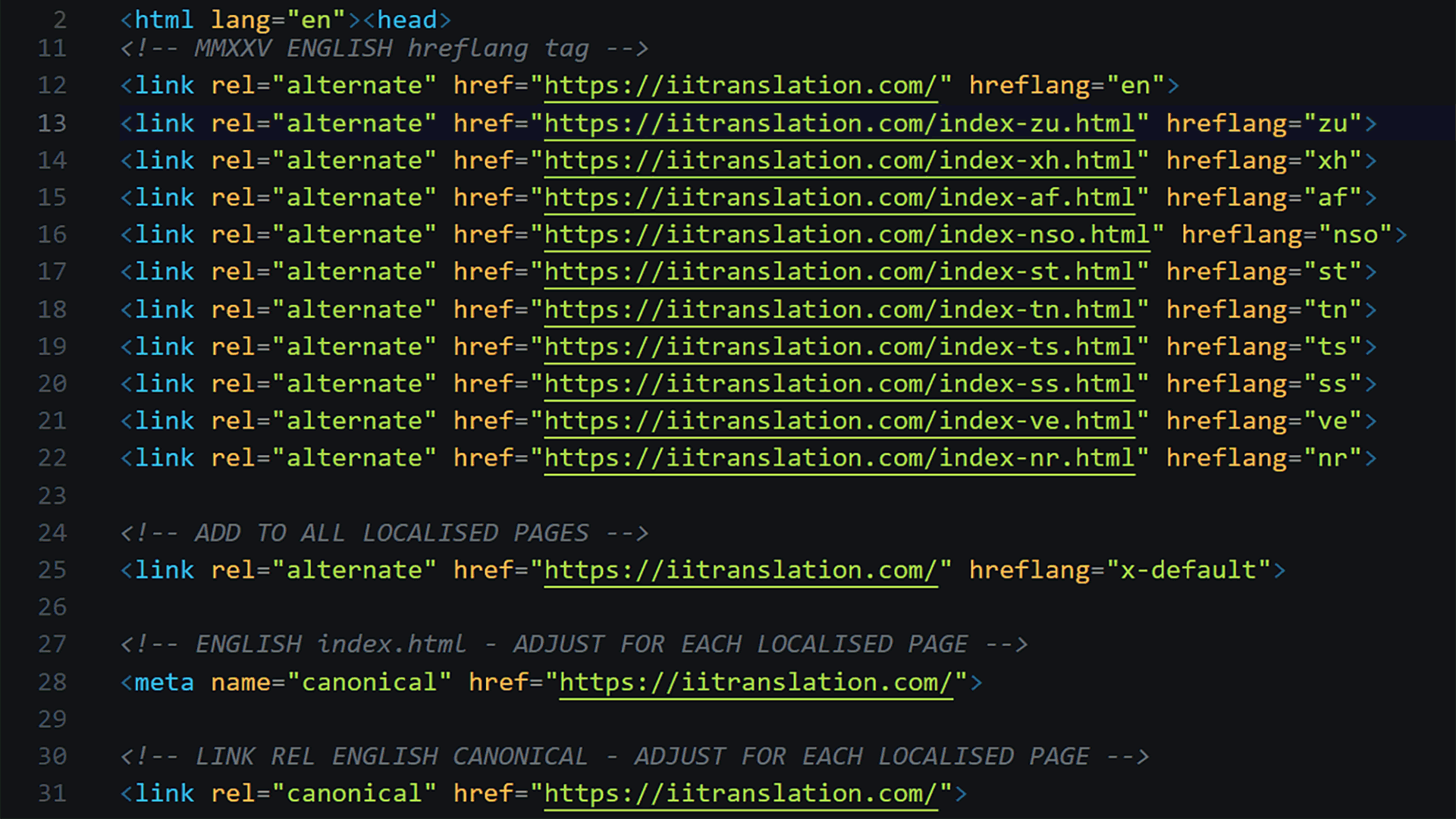 Code showing hreflang implementation for 11 official South African languages on the iiTranslation homepage, proving multilingual SEO compliance.
Technical Proof: Maximise South African Reach with hreflang Mastery
True website localisation goes beyond translation, it demands technical precision. This code from our own site demonstrates our mastery of hreflang tags. We ensure search engines like Google correctly index your content and serve the right language version to the right user, maximising your organic reach across South Africa and eliminating the risks of faulty international SEO.
Reaching All South Africans: More Than Just Translation
Reaching the majority of South Africans online is not just a linguistic challenge, it's an implementation one. Most organisations have the intention but struggle to combine accurate translation with correct technical execution across 11 languages simultaneously.
We handle both. Every language version is translated by a certified, first-language translator and implemented with correct hreflang tags, so search engines serve the right version to the right user. The result is a website that genuinely works for all of South Africa.
Human Expertise vs. Machine Translation
Your website's localisation is only as strong as its translators. That is why we apply South Africa's most rigorous standards. For full details on our academic and professional criteria, see our Quality section. Every project is assigned to a certified, first-language translator with a minimum of 10 years' experience and a relevant academic qualification from a South African university.
This commitment to certified human expertise is your safeguard against automated translation. Global AI cannot grasp the cultural subtleties of South Africa's 11 official languages, often producing results that are awkward, flawed and culturally tone-deaf.
We eliminate this risk. We ensure your content is not just grammatically accurate, but also culturally appropriate and meaningful to your audience, building the confidence essential for true audience connection.
Get a Certified Website Translation Quote
Our certified, first-language translators deliver accurate website localisation into all 11 official South African languages, with correct hreflang implementation for multilingual SEO. Email us at info@iitranslation.com with a link to your website, the languages you need and your target deadline. If you are unsure which languages best serve your target provinces, we are happy to advise. We answer all requests within five minutes during business hours (7:30am - 5pm SAST, Monday to Friday).
Frequently Asked Questions: Website Translation and Localisation
What is the difference between website translation and localisation?
Translation converts the words of your website from one language to another. Localisation does that and goes further, adapting the content so it is culturally appropriate, contextually accurate and genuinely resonant for the target audience. For a South African multilingual website, the distinction matters in practical ways. A translated page might be grammatically correct in isiZulu but use a register that feels formal and distant to a Soweto reader who came to the site looking for a service. A localised page speaks in the voice that community uses and trusts. Our process combines both: every page is translated by a certified, first-language translator with a minimum of 10 years' experience who understands not just the language but the community it serves. English is the home language of fewer than one in ten South Africans. A website that only exists in English is not a South African website. It is a website for a minority of the country.
What are hreflang tags and why do they matter for a multilingual South African website?
Hreflang tags are lines of code in your website's HTML that tell Google which language version of a page to serve to which user. Without them, or with them incorrectly implemented, Google cannot reliably identify that your isiXhosa page exists for an isiXhosa-speaking user, or that your Afrikaans version should appear in search results for an Afrikaans speaker in the Western Cape. The consequence is that your translated pages go largely unindexed and the investment in translation produces no organic search benefit. Correct hreflang implementation for 11 languages is technically demanding. Each page in each language must reference all other language versions correctly, and a single error in the tag set can cause Google to treat multiple pages as duplicates rather than language variants. We handle implementation as part of our website localisation service, not as an optional add-on. Our own website runs hreflang tags for all 11 official South African languages, which you can inspect directly in the page source. See our hreflang implementation as a working example.
How can I see proof of your website translation quality before committing?
Our own website is the most direct demonstration we can offer. Our homepage has been professionally translated by first-language linguists into all 11 official South African languages. If you have home language proficiency in any of them, you can read our site in that language right now and assess the register, terminology and fluency for yourself. The relevant homepages are: isiZulu, isiXhosa, Afrikaans, Sepedi, Setswana, Sesotho, Xitsonga, Siswati, Tshivenḓa and isiNdebele. We are not aware of another translation agency in South Africa that publishes its own website in the languages it claims to translate into. The hreflang implementation is also visible in the page source code for any developer who wants to inspect it.
Which languages should I prioritise for my South African website?
The right answer depends on your audience, your sector and your geographic reach. For organisations operating nationally, the three languages with the broadest combined reach are isiZulu (spoken by 23.8% of South Africans), isiXhosa (16.3%) and Afrikaans (10.6%). These three together reach more than half the country. For organisations with a strong Western Cape presence, Afrikaans and isiXhosa are the clear priorities. For Gauteng-focused organisations, Sesotho and Setswana become important alongside isiZulu. For public sector organisations with a constitutional obligation to communicate with all communities, translating your English webpage to 10 languages may be required. We are happy to advise on the right language strategy for your specific audience and budget before you commit to a quote. You can also explore language demographics by province in our language statistics table.
What file formats do you work in for website translation?
We work directly with your development or design team and adapt to whatever tools they use, from GitHub and Visual Studio Code to WYSIWYG editors like WordPress. Whatever the source format, all content is imported into MS Word before translation begins. Word gives our translators the full editorial environment they need, with native spelling and grammar checks, tracked changes and inline commenting that are not available in dedicated translation tools. This is where the actual linguistic work happens. We accept and return content in HTML (individual pages or exported templates), XML (CMS exports, app strings and structured content files) and CSV (spreadsheet-based content inventories and e-commerce product data). If you are unsure which format suits your platform, send us a sample file and we will confirm the cleanest approach with your team before the project begins.
Does machine translation or AI damage a website's SEO performance?
Yes, in two distinct ways. The first is a content quality signal: Google's systems are increasingly capable of identifying machine-translated content and treat it as low-quality, which suppresses rankings. A site with 11 language versions produced by AI may be penalised rather than rewarded, because the translated pages add no genuine value to a user. The second is user behaviour: when a visitor lands on a page in their home language and the text is awkward, unnatural or culturally wrong, they leave immediately. A high bounce rate from a language-specific page tells Google that the page did not satisfy the user's intent, which compounds the ranking damage. A properly translated and localised website has the opposite effect: visitors who find content in their own language spend more time on the site, engage more deeply and are more likely to convert. The investment in professional translation compounds over time through improved organic reach and engagement across all 11 language versions.
Can you translate our website if it is built on WordPress, Shopify or another CMS platform?
Yes. The translation work itself is platform-agnostic. We translate the content, not the CMS. For most platforms the practical question is how to extract the content cleanly for translation and return it without formatting errors. WordPress sites typically export via XML or through translation plugins that produce file sets we can work from directly. Shopify product and content data exports to CSV. Custom-built sites export via HTML or JSON depending on the stack. We bring everything into MS Word for translation, which means the returned files are clean and predictable regardless of where they came from. We do not manage CMS setup or multilingual plugin configuration, but we are happy to advise on the most practical handoff approach and to liaise directly with your development team if that helps move the project along.
What does website translation cost and how long does it take?
We price all website translation projects on a transparent per-word basis with no hidden fees. The figure in your quote is the final amount. Rates vary by language, with some languages requiring more specialist linguists than others, but we never charge premium fees for faster turnarounds. Our minimum project cost is R500 + VAT. Turnaround depends primarily on total word count and the number of language versions required. A focused campaign site of 2,000 words in three languages is a different scale of project from a full corporate site of 20,000 words into ten languages, and we plan and schedule accordingly. If the right linguist for one of your languages is not immediately available, we will flag this with your project team before work begins rather than after. Most clients receive a quote within 5 minutes of sharing their content or a link to their site during business hours. For larger projects we provide a phased delivery plan with milestones so your development team can begin implementation while subsequent language versions are still in progress.
Clients